
Data Consulting
We support organizations in attaining the highest value from their data through highly customized consulting services. Whether it’s developing a data strategy and architecture, conducting maturity assessments, or technology advisory, we align your data initiatives closer to your business goals to deliver results.

Data Engineering
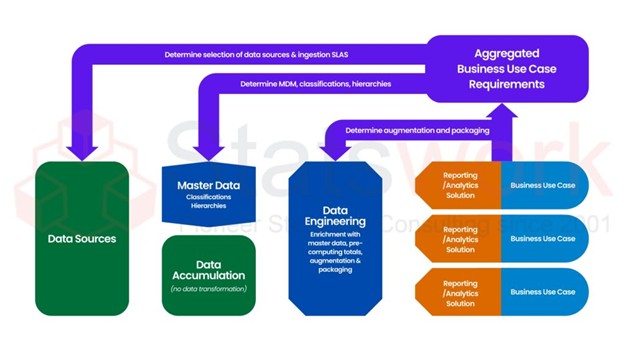
Our data engineering services include designing, building, and maintaining resilient data pipelines/infrastructures. We ensure that structured and unstructured data flows reliably from your source to your insight, whether through real-time data or batch processing.

Advanced Analytics and AI
We provide organizations with predictive insights and intelligent automation through machine learning, statistical modelling, and AI solutions. We turn data into a competitive advantage – whether it be forecasting customer behaviour or optimizing workflows and operations.

Data Security, Governance, and Compliance
We develop robust data governance frameworks and enforce security best practices, ensuring your data remains protected, compliant, and reliable. Our services help you meet regulations (GDPR, HIPAA, etc.), improve risk, and ensure integrity across the enterprise.











Domain-aligned insights
3 expert reviewers on all projects decrease relevance issues and aligns the insights you receive.

Fast & scalable workflows
Rapid data analysis pipelines, aligned to ML environment.

Secure & complaints
Consistently supported by signed NDAs, privacy policies, and regulatory-ready (GDPR, HIPAA, etc.).

Trusted AI data partner
We deliver clean, contextual, and analysis-ready data for intelligent automation.






1. Define the analytical purpose
Specify the objectives of the AI/ML project that were established through a business case or research endeavor. Enumerate the insights or predictions you require—including any data to support these.

2. Profile and explore the data
Perform exploratory data analysis (EDA)this could include many facets, including an understanding of data distribution, detection of outliers, assessment of data quality, and the detection of patterns or bias that may impact model performance.

3. Engineer and select features
Engineer and extract informative variables applying statistical knowledge and domain expertise—and apply relevance filters—removing irrelevant features with little impact on accuracy and interpretability.

4. Clean and transform data
Standardize and normalize data—and not forget to consider missing values and outlier dimension reduction where necessary to ensure optimal model performance whilst retaining model integrity.

5. Human-in-the-loop review (Important)
Statistical analysts or subject-matter-experts must sign off on the logic of features, examine for bias or drift, and legitimate data transformations, and ensure alignment with industry regulations and operational goals.

6. Deliver and span downstream
The final analysis-ready datasets are delivered to use with ML pipelines, dashboards, or APIs, where they can be fed into model training and testing: - integrating modelling and natural applicability with real-time usability, deployment and envisaged scaling.


"Statswork transformed our messy clinical data into a streamlined dataset that significantly improved our diagnostic model’s accuracy. Their domain understanding and attention to data relevance was unmatched."
Healthcare AI Startup – USA,
CTO, AI Healthcare Solutions

"We relied on Statswork’s data analysis team to refine our features for a credit scoring engine. Not only did our model performance improve by 30%, but we also gained much clearer insights into customer behavior."
FinTech Company – UK,
Lead Data Scientist, FinEdge Tech
"From initial data exploration to human-in-the-loop validations, Statswork helped us build a transparent ML pipeline ready for publication and peer review. Their expertise in reproducibility was invaluable."
Research Institute – Germany,
Principal Investigator, AI for Sustainability Lab
"Their feature engineering and cleansing workflows allowed us to deploy predictive models that improved customer retention and basket size. We saw results in weeks, not months."
E-commerce Platform – India
Chief Data Officer, ShopSmart Retail