


What are PRISMA Guidelines?
- Home
- Insights
- Article
- What are PRISMA Guidelines?
Qualitative Research Service
News & Trends
Recommended Reads

Data Collection
As the data collection methods have extreme influence over the validity of the research outcomes, it is considered as the crucial aspect of the studies
- 1. Introduction
- 2. DeepHealth’s Diagnostic Suite™: Revolutionizing Radiology Workflows
- 3. Key Features
- 4. AI Impact on National Screening Programs
- 5. SmartMammo™: Enhancing Breast Cancer Screening
- 6. DeepHealth AI Use Cases Across Specialties
- 7. Strategic Collaborations and Ecosystem Expansion
- 8. Impact and Adoption of DeepHealth’s AI Solutions
- 9. Conclusion: The Future of Radiology with AI
- 10. References
Introduction
PRISMA Guidelines, which stand for “Preferred Reporting Items for Systematic Reviews and Meta-Analyses”, are internationally recognized principles aimed at enhancing the clarity and effectiveness of systematic review and meta-analysis study design. PRISMA assists scientists in systematically searching, appraising, and synthesizing evidence.
The use of PRISMA Guidelines in healthcare, education, psychology, nursing, business, and other types of social sciences has been widely recognized to increase credibility and reliability of the studies. Keywords for SEO purposes: PRISMA Guidelines, systematic review, meta-analysis guidelines, PRISMA checklist. [1]
Understanding the Importance of PRISMA Guidelines
The PRISMA Guidelines play a very important role in conducting systematic reviews and meta-analyses due to their ability to make scientific research reporting transparent, consistent, and accurate. The PRISMA guidelines make it possible to structure the presentation of the research methodology, reducing the chances of bias.
- Reduces the Risk of Selection Bias: PRISMA makes it possible for researchers to use precise inclusion and exclusion criteria.
- Increases Research Transparency: PRISMA clearly describes how the research is conducted and the results obtained.
- Ensures Methodological Consistency: PRISMA provides a standard for presenting systematic reviews.
- Enhances Research Credibility: It ensures accurate and transparent reporting. [1]
Key Components of PRISMA Guidelines
The main features of PRISMA include the use of PRISMA checklist and flow diagram, which help the researcher in all stages of systematic review and meta-analysis writing.
Important Features Include:
- Title of research
- Structured abstract of research
- Objectives of research
- Review questions
- Selection criteria
- Information sources
- Data extraction
- Assessment of bias
- Statistics and synthesis of results
- Discussion of results
The PRISMA checklist ensures that the researcher includes all important information about methodology in his work. [2]
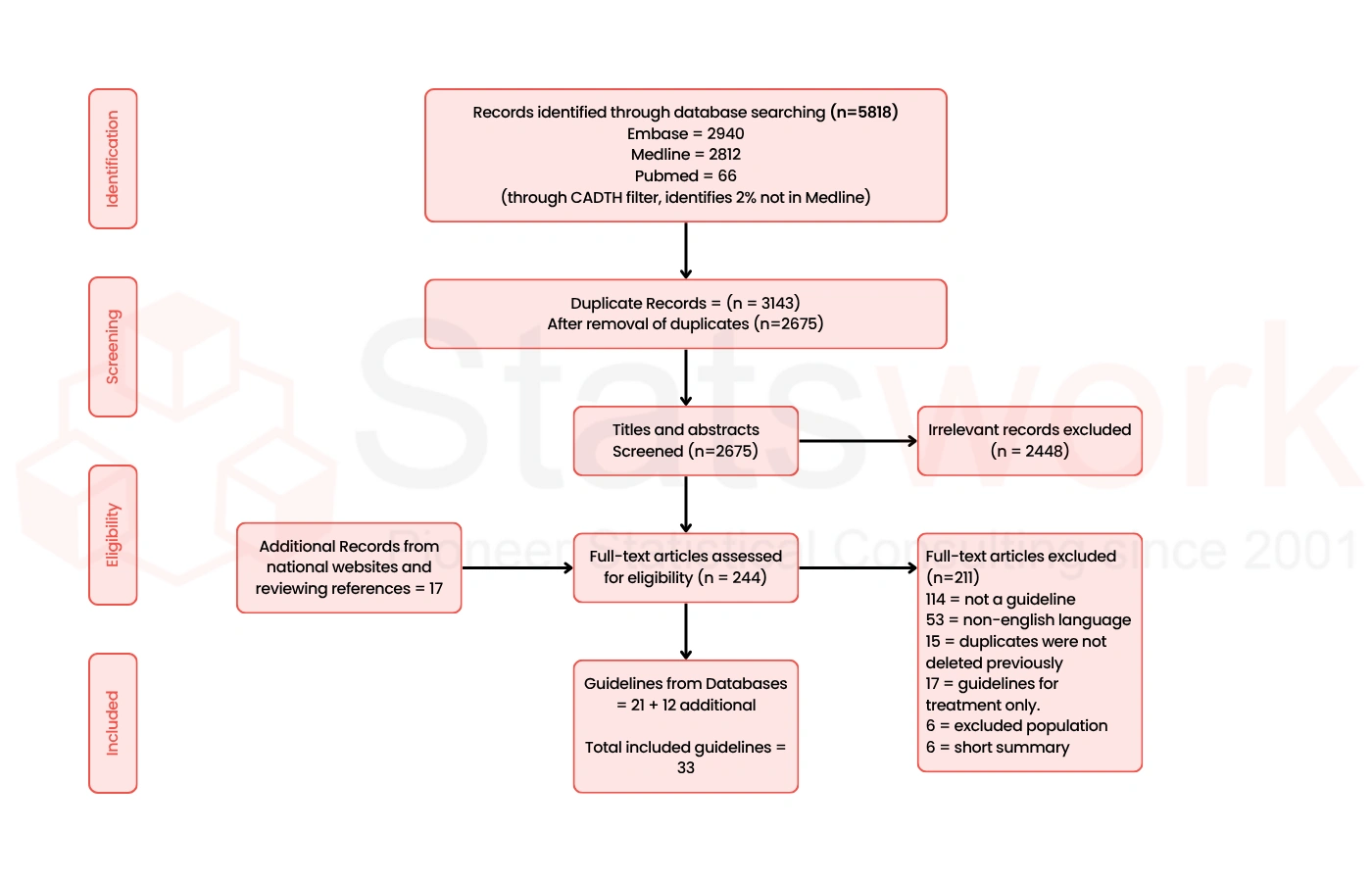
PRISMA Flow Diagram Process
| PRISMA Stage | Description | Purpose in Meta-Analysis |
| Identification | Collection of studies from databases and journals | Ensures comprehensive literature search |
| Screening | Removal of duplicate and unrelated studies | Improves relevance and quality |
| Eligibility | Full-text evaluation using inclusion criteria | Reduces selection bias |
| Included Studies | Final studies selected for meta-analysis | Supports accurate evidence synthesis |
The PRISMA flow diagram illustrates how the studies go through different stages to be included in the final meta-analysis. [3]
How PRISMA Improves Research Quality
The PRISMA guidelines help improve research quality through better reporting of results in systematic reviews and meta-analysis.
- Improves Methodological Clarity: The researchers are able to explain their methodology, search strategies, and the procedure for collecting data.
- Reduces Reporting Errors: There are fewer errors in systematic review results due to structured reporting.
- Enhances Research Reproducibility: Replication becomes easier for other researchers to test the accuracy of the results produced in the study.
- Increases Academic Credibility: The results from the PRISMA-based studies become more reliable and acceptable by journal and research institutions.
- Supports Evidence-Based Decisions: Reporting is done transparently to enable better decision-making based on research results. [4]
Benefits of Using PRISMA Guidelines
Adhering to PRISMA criteria provides many benefits that can be very advantageous for scientists and scholars.
Advantages include:
- Greater transparency and consistency
- Lesser reporting bias and selection bias
- Better quality systematic reviews
- Promoting evidence-based decision making
- Higher chance of journal publication
- Improving research reliability and reproducibility
These advantages ensure that PRISMA is considered among the most recommended methodologies used in systematic review reporting and meta-analysis studies. [5]
Conclusion
The use of PRISMA Guidelines is vital in ensuring that systematic reviews and meta-analysis are more accurate, reliable, and transparent. It offers a set of procedures which make it easy for researchers to describe their methodology and results.
PRISMA increases the reproducibility of studies, hence making it easier for other researchers to validate the results. PRISMA is a widely used guideline that supports evidence-based research and increases research validity. With the increasing popularity of systematic reviews, PRISMA is likely to be relevant for many years to come.
Publish with confidence using Statswork’s end-to-end meta-analysis support backed by structured PRISMA Guidelines and accurate evidence synthesis.
References
- Page, M. J., McKenzie, J. E., Bossuyt, P. M., Boutron, I., Hoffmann, T. C., Mulrow, C. D., … & Moher, D. (2021). The PRISMA 2020 statement: an updated guideline for reporting systematic reviews. bmj, 372. https://www.bmj.com/content/
- Arya, S., Kaji, A. H., & Boermeester, M. A. (2021). PRISMA reporting guidelines for meta-analyses and systematic reviews. JAMA surgery, 156(8), 789-790. https://jamanetwork.com/
- Tricco, A. C., Lillie, E., Zarin, W., O’Brien, K. K., Colquhoun, H., Levac, D., … & Straus, S. E. (2018). PRISMA extension for scoping reviews (PRISMA-ScR): checklist and explanation. Annals of internal medicine, 169(7), 467-473. https://www.acpjournals.org/
- Sánchez-Martín, M., Rubio-Aparicio, M., López-García, G. D., & Navarro-Mateu, F. (2026). How to improve the quality and transparency of systematic review? PRISMA 2020 guideline. Cuadernos del Profesorado, 19(39), 107. https://search.proquest.com/
- Mishra, V., & Mishra, M. P. (2023). PRISMA for review of management literature–method, merits, and limitations–an academic review. https://www.emerald.com/book