
What is secondary data collection for market research?
- Home
- Insights
- Article
- What is secondary data collection for market research?
Qualitative Research Service
- The Concept of Secondary Data Collection
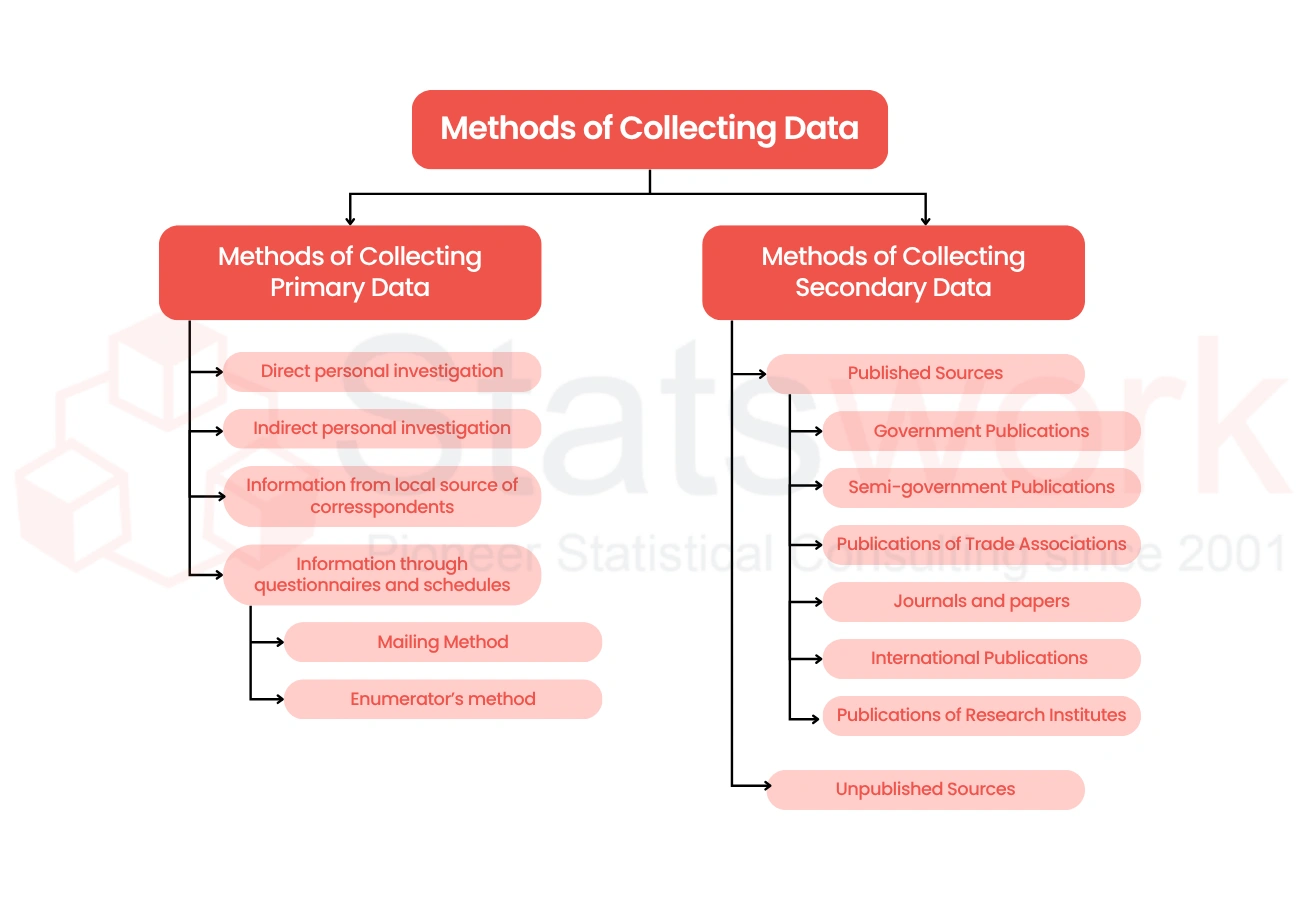
- Types of Secondary Data Collection
- Sources of Secondary Data Collection
- Secondary Data Collection Importance in Market Research
- Benefits of Collecting Secondary Data
- Challenges Encountered in Collecting Secondary Data
- Secondary Data Collection vs Primary Data Collection
- Secondary Data Collection Applications
- Why Businesses Prefer Secondary Market Research
- Conclusion
News & Trends
Recommended Reads

Data Collection
As the data collection methods have extreme influence over the validity of the research outcomes, it is considered as the crucial aspect of the studies
- 1. Introduction
- 2. DeepHealth’s Diagnostic Suite™: Revolutionizing Radiology Workflows
- 3. Key Features
- 4. AI Impact on National Screening Programs
- 5. SmartMammo™: Enhancing Breast Cancer Screening
- 6. DeepHealth AI Use Cases Across Specialties
- 7. Strategic Collaborations and Ecosystem Expansion
- 8. Impact and Adoption of DeepHealth’s AI Solutions
- 9. Conclusion: The Future of Radiology with AI
- 10. References
Introduction
Market Research Secondary Data Collection Process refers to the gathering of data that already exists from various sources such as published materials, reports, surveys, journals, and other sources. Rather than carrying out any survey or interview, businesses collect data to learn about the latest trends in the market [1].
The secondary data collection process is highly popular among new startups, companies, marketers, and other professionals. This process assists businesses in understanding consumer behavior, competitive environment, pricing, demands, and growth in the industry.
The Concept of Secondary Data Collection
Secondary data collection consists of collecting existing data by an external entity, which was intended for some other purpose. Firms examine such data to comprehend the state of the market, customers’ expectations, competitiveness within the industry, and possible new opportunities.
As a case in point, if a firm in the food and beverages industry were to introduce a new, healthy snack, it would need to review various industry studies, customer opinions on the Internet, health trends, and competitors’ statistics [2].
This type of research has a high significance due to its economic efficiency.
Types of Secondary Data Collection
1. Internal Secondary Data
Internal secondary data is the data that is readily available within the organization.
Examples include:
- Sales reports
- Customer databases
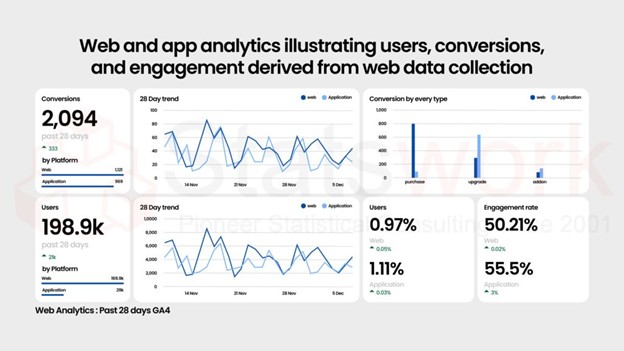
- Website analytics
- CRM data
- Inventory
- Marketing campaigns’ performance
- Research reports made in the past
Advantages:
- Easy access to data
- Low cost
- Give insight into the business
- Helps in analyzing the behavior of customers
2. External Secondary Data
External secondary data is sourced externally from agencies, institutions, academic institutions, and the internet.
Examples include:
- Statistics by the government
- Industry reports
- Academic journals
- Trade magazines
- Market research reports
- Social media analytics
- News stories
Advantages:
- Broad insights into the market
- Analyzing competition
- Forecasting trends
Sources of Secondary Data Collection
| Type of Source | Description | Examples |
| Government Publications | Statistics and economics-related data available to the public | Census reports, trade data |
| Industry Reports | Market insights and growth | Statista, Nielsen, IBISWorld |
| Academic Journals | Studies based on research findings | University research publications |
| Online Databases | Business and market data on the Internet | Google Trends |
| Company Reports | Analysis of competitors and finances [3] | Annual reports |
| Social Media Platforms | Consumer opinions and engagement data | Instagram, LinkedIn, X |
Secondary Data Collection Importance in Market Research
Secondly, data collection enables companies to take well-informed and intelligent business decisions with reliable and readily available data. This type of data collection provides a solid basis for trend identification, customer analysis, and performance assessment within the market.
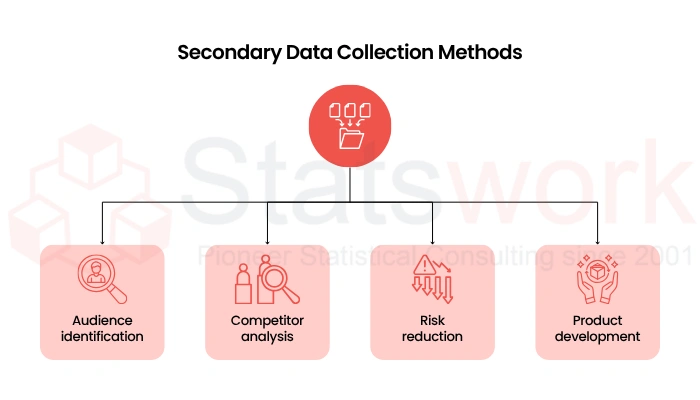
Some of the uses of secondary data by firms include:
- Audience identification
- Competitor analysis
- Business opportunity identification
- Market demand analysis
- Industry growth prediction
- Risk reduction
- Product development
Firms that conduct effective secondary data analysis enjoy faster decision-making and lower operational costs [4].
Benefits of Collecting Secondary Data
Cost Reduction
Research through surveys and field visits may be costly. Using secondary data reduces these expenses due to use of existing data.
Time Saving
The organizations can obtain the required data on an instant basis instead of taking several months in data collection.
Quick Access to Extensive Data Set
The researcher does not need to conduct a large-scale survey to get data from different industries, markets, and demographics.
Enables Market Trend Analysis
Secondary data enables organizations to analyze trends both past and present for better forecasting and planning [5].
Improving Organizational Decision Making
Using secondary data helps businesses make informed decisions based on market analysis.
Challenges Encountered in Collecting Secondary Data
| Challenge | Reason |
| Information Is Outdated | Some reports could fail to represent the present state of the market |
| Specificity Problems | Available data may not meet the research needs |
| Accuracy Problems | Provided information could come from non-reliable sources |
| Incompleteness Problem | Not all data sets may provide adequate details |
Secondary Data Collection vs Primary Data Collection
| Factor | Secondary Data Collection | Primary Data Collection |
| Data Source | Data already existing | Data directly gathered |
| Cost | Cheaper | Expensive |
| Time | Could be quick | Could be time consuming |
| Accuracy | May vary | Highly accurate |
| Purpose | General overview | Specific purpose |
Many businesses combine both primary and secondary research methods for more accurate market analysis [3].
Secondary Data Collection Applications
Trend Analysis in Markets
Firms analyze the trends that emerge by assessing industry reports and economic trends in markets.
Analysis of Competitors
Organizations conduct analysis to evaluate the prices, strategies, positions, and feedback from customers on competitors’ products.
Product Planning
Organizations examine the requirements of customers and identify industry gaps for new product development.
Behavior of Customers
The behavior of customers is studied through digital analytics and online reviews of their preferences [4].
Investment and Risk Analysis
It enables firms to analyze the risks, market trends, and opportunities in the investment process.
Why Businesses Prefer Secondary Market Research
Secondary market research is one of the most practical and effective forms of research used by contemporary businesses. This approach enables companies to get useful data in a quick and cost-effective manner.
Secondary market research helps various businesses to:
- Enhance strategic decision-making
- Develop products effectively
- Satisfy consumer needs
- Outperform competitors
- Innovate and create new solutions
- Minimize market risks
For any business that operates within a highly competitive environment, secondary market research can prove to be very useful [3].
Conclusion
Secondary market research is an indispensable activity that helps organizations collect relevant information from different data sources. It is used extensively for analyzing the trends of the market, customer behavior, industrial performance, and competitive position without engaging in costly field research.
Even though there might be some disadvantages like less precise or outdated data, secondary research still stands out among all other research methodologies as being cost-effective and efficient. With the help of reliable data sources, companies can make better decisions [5].
Other businesses that wish to enhance their market research efforts and obtain industry insights may also request a free consultation to learn about market research solutions tailored to their needs. Other businesses that wish to enhance their market research efforts and obtain industry insights may also request a free consultation to learn about market research solutions tailored to their needs.
Reference
- Auerbach, R. P., Mortier, P., Bruffaerts, R., Alonso, J., Benjet, C., Cuijpers, P., Demyttenaere, K., Ebert, D. D., Green, J. G., Hasking, P., Murray, E., Nock, M. K., Pinder-Amaker, S., Sampson, N. A., Stein, D. J., Vilagut, G., Zaslavsky, A. M., Kessler, R. C., & WHO WMH-ICS Collaborators (2018). WHO World Mental Health Surveys International College Student Project: Prevalence and distribution of mental disorders. Journal of abnormal psychology, 127(7), 623–638. https://doi.org/10.1037/abn00003
- Paller, A. S., Simpson, E. L., Siegfried, E. C., Cork, M. J., Wollenberg, A., Arkwright, P. D., Soong, W., Gonzalez, M. E., Schneider, L. C., Sidbury, R., Lockshin, B., Meltzer, S., Wang, Z., Mannent, L. P., Amin, N., Sun, Y., Laws, E., Akinlade, B., Dillon, M., Kosloski, M. P., … participating investigators (2022). Dupilumab in children aged 6 months to younger than 6 years with uncontrolled atopic dermatitis: a randomised, double-blind, placebo-controlled, phase 3 trial. Lancet (London, England), 400(10356), 908–919. https://doi.org/10.1016/S0140-6736(22)01539-2
- Franco, J. S., & Vizcaya, D. (2020). Availability of secondary healthcare data for conducting pharmacoepidemiology studies in Colombia: A systematic review. Pharmacology research & perspectives, 8(5), e00661. https://doi.org/10.1002/prp2.661
- Jørgensen, J., Mungapen, L., & Kefalas, P. (2019). Data collection infrastructure for patient outcomes in the UK – opportunities and challenges for cell and gene therapies launching. Journal of market access & health policy, 7(1), 1573164. https://doi.org/10.1080/20016689
- Parente, S. T., & Phelps, C. E. (2023). Reimagining Patient Data Access for Researchers. Value in health: the journal of the International Society for Pharmacoeconomics and Outcomes Research, 26(9), 1329–1333. https://doi.org/10.1016/j.jval.2023