
Creating Assessment that Matter: Best Practices for Custom Survey Design
- Home
- Insights
- Article
- Creating Assessment that Matter: Best Practices for Custom Survey Design
Qualitative Research Service
News & Trends
Recommended Reads

Data Collection
As the data collection methods have extreme influence over the validity of the research outcomes, it is considered as the crucial aspect of the studies
- 1. Introduction
- 2. DeepHealth’s Diagnostic Suite™: Revolutionizing Radiology Workflows
- 3. Key Features
- 4. AI Impact on National Screening Programs
- 5. SmartMammo™: Enhancing Breast Cancer Screening
- 6. DeepHealth AI Use Cases Across Specialties
- 7. Strategic Collaborations and Ecosystem Expansion
- 8. Impact and Adoption of DeepHealth’s AI Solutions
- 9. Conclusion: The Future of Radiology with AI
- 10. References
Introduction
With today’s increasing reliance on technology and data to inform business decisions, customized surveys and evaluations have emerged as essential tools for organizations looking to obtain the information they need.
Customized assessments give organizations access to pertinent information they can utilize for their decision-making processes, increasing efficiency and helping organizations provide an improved experience for their customers. This article provides a detailed overview of the best practices for designing custom surveys that will produce useable data.[1]
Understanding the Foundation of Custom Surveys
The Power of Customization
- Custom surveys are created specifically for a business’ needs.
- Custom surveys can focus on customer experience, employee engagement or education outcomes, etc.
- Custom assessments provide organizations with actionable data by ensuring alignment between the assessment and organizational goals.
- Custom survey designs maximize the quality of insights by providing relevance to the respondents.
Defining Clear Objectives
- Clearly define the goals of your survey before you write the questions.
- Clearly determine the decisions that your survey will support.
- The purpose of your survey must align with every question you write.
- To maximize the value that your respondents will receive, prevent irrelevant content from appearing in your survey.[2]
Crafting Effective Questions for Meaningful Data
| Question Types |
|
| Clarity |
|
| Bias Prevention |
|
| Cultural Sensitivity |
|
| Scales and Ratings |
|
Structuring the Survey for Maximum Engagement
Survey Flow and Organization
- Be creative and make the opening interesting!
- The introduction should contain broad questions and narrower questions afterwards!
- Both similar types of questions should be placed together to have a smooth transition.
Engagement Tactics: Minimizing Fatigue
- Surveys should be as short as possible; it makes fatigue less likely.
- For long surveys consider using section headings.
- Provide visual indicators of progress.
Personalization: Using Dynamic Questioning
- Customise the survey based on the answers provided before.
- Increase the relevance of your survey, thereby increasing completion rates.[3]
Testing, Pretesting, and Repeating for Accuracy
The Pretest is Valuable:
- Pilot testing a small sample of respondents will identify potential problems in terms of wording (confusing), technical issues and/or items that may have been overlooked.
- This process will help guarantee that respondents have the same understanding of the survey as intended and be able to improve upon by adjusting accordingly.
A Continuous Design Process:
- The design of a survey changes throughout the life of a project; use the feedback received during this first round of testing to improve on subsequent tests of your questionnaire.
- Experimenting with new patterns, question types and order, will help you determine which designs work best for your target population.[4]
Collecting, Analysing, and Applying Data
Data Collection Best Practices
- Select the appropriate platform (e.g., email, social media, website).
- Schedule your surveys for peak times of engagement.
- Use incentives to increase your response rates.
Analysing Responses
- Use quantitative analysis (e.g., descriptive statistics).
- Conduct qualitative analysis (e.g., sentiment analysis).
- Analyse the data to find actionable insights that can inform actionable items.
Acting on Insights
- Use data collection to guide strategic decisions.
- Identify opportunities for improvement based on your findings.
- Share your findings with stakeholders to foster engagement moving forward.[4]

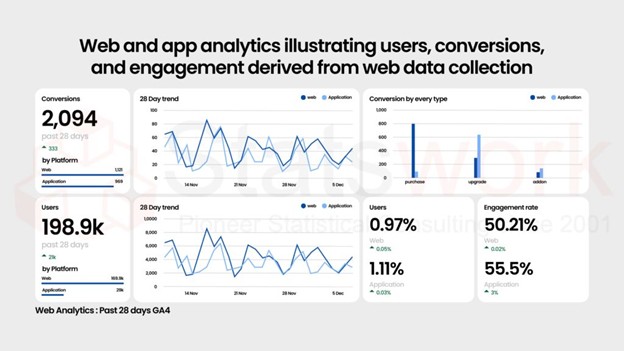
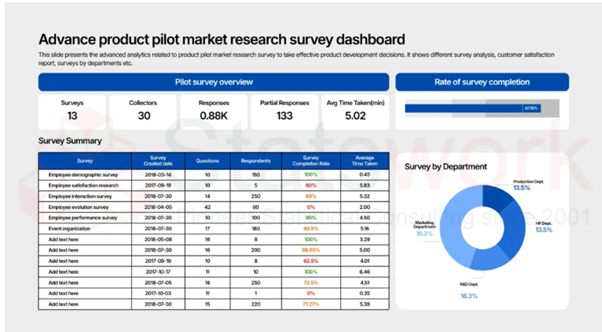
Fig 1 shows the survey data of customer satisfaction levels and key survey metrics.
Ethical Considerations and Data Integrity
Privacy and Confidentiality
- Always Protect the Privacy of Your Survey Respondents. The information you collect should be anonymous (if possible).
- If the data cannot be anonymous, you must inform the respondent about how their data will be used.
- Take precautions to prevent unauthorized access to the data collected, and comply with applicable privacy laws (e.g., GDPR).
Transparency and Consent
- Informed Consent for Your Survey Respondents. Clearly communicate the reason for conducting the survey to the respondents.
- Explain to them how you will use their data and how long it will be stored.[5]
Conclusion
A successful assessment takes time and effort to plan, design the right questions, and commit to the survey analysis of the responses. When done correctly, customized surveys can provide in-depth information about your employees, customers, or stakeholders that can help improve processes, facilitate more informed decisions, and build greater trust and loyalty.
By utilizing best practices for designing surveys, you can not only collect data but also develop a greater awareness of the value of the survey, enabling both you and your organization to work towards achieving successful and engaged employees and customers.
Elevate your survey strategy with StatsWork—reach out for custom solutions!
Reference
- Jankowski, N. A., Timmer, J. D., Kinzie, J., & Kuh, G. D. (2018). Assessment that matters: Trending toward practices that document authentic student learning. National Institute for Learning Outcomes Assessment. https://eric.ed.gov/?id=ED590514
- Lipsey, R. G. (1992). The theory of customs unions: A general survey. In International economic policies and their theoretical foundations(pp. 193-212). Academic Press. https://www.sciencedirect.com/science/chapter/edited-volume/abs/pii/B9780124442818500143
- Sharma, H., & Ruikar, M. (2025). Crafting an effective questionnaire: An essential prerequisite of engaging surveys. Perspectives in Clinical Research, 10-4103. https://journals.lww.com/picp/fulltext/2025/07000/crafting
- Diamantopoulos, A., Reynolds, N., & Schlegelmilch, B. (1994). Pretesting in questionnaire design: The impact of respondent characteristics on error detection. Market Research Society. Journal., 36(4), 1-15. https://journals.sagepub.com/doi/abs/10.1177/147078539403600402
- Griffin, M., Martino, R. J., LoSchiavo, C., Comer-Carruthers, C., Krause, K. D., Stults, C. B., & Halkitis, P. N. (2022). Ensuring survey research data integrity in the era of internet bots. Quality & quantity, 56(4), 2841-2852. https://link.springer.com/article/10.1007/s11135-021-01252-1