
What is Data Monetization Strategy?
- Home
- Insights
- Article
- What is Data Monetization Strategy?
Qualitative Research Service
News & Trends
Recommended Reads

Data Collection
As the data collection methods have extreme influence over the validity of the research outcomes, it is considered as the crucial aspect of the studies
- 1. Introduction
- 2. DeepHealth’s Diagnostic Suite™: Revolutionizing Radiology Workflows
- 3. Key Features
- 4. AI Impact on National Screening Programs
- 5. SmartMammo™: Enhancing Breast Cancer Screening
- 6. DeepHealth AI Use Cases Across Specialties
- 7. Strategic Collaborations and Ecosystem Expansion
- 8. Impact and Adoption of DeepHealth’s AI Solutions
- 9. Conclusion: The Future of Radiology with AI
- 10. References
Introduction
The strategy to monetize data allows enterprises to add value through the application of data obtained from an enterprise in making decisions and growing strategically. Enterprises generate substantial amounts of both structured and unstructured data from their customers, applications, websites, and internal operations in today’s economy.
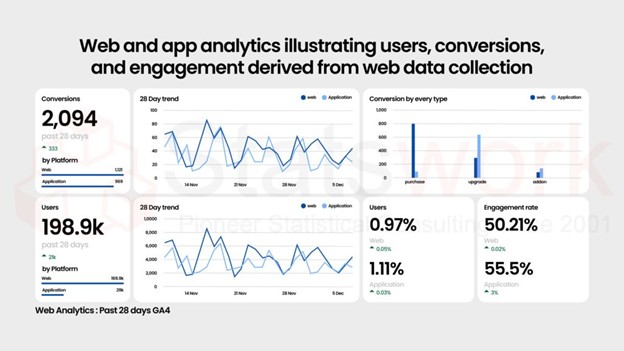
Analytics is crucial in turning collected data into useful information for businesses. Analytics enables businesses to discover patterns, engage more with customers, become more efficient, sell more, and have greater competitive advantages in a changing environment. [1]
Importance of Data Analytics in Data Monetization
Data analytics allows companies to convert raw data into useful insights which can aid growth and income generation for the company.
- Analysis of Customer Behaviour: Data analytics allows an organization to know the interests and customer behaviour prediction, which further contributes to personalization and effective engagement.
- Predictive Decision Making: The predictive analytics involves forecasting trends, which helps in identifying future business opportunities.
- Optimizing Operations: Businesses use data analytics to improve efficiency in their operations.
- Reducing Risks and Detecting Fraud: The use of data analytics allows businesses to detect risks and even cases of fraud and improve their data security.
- Generating Income: Data analytics assists firms in making decisions as well as generating new income possibilities through the analysis of data. [2]
Major Components of a Data Monetization Strategy
A successful data monetization approach needs to contain a number of vital ingredients in order to achieve sustainable results in the future. These include,
| Component | Description | Business Benefit |
| Data Collection | Gathering structured and unstructured data from multiple sources | Improved data availability |
| Data Integration | Combining data from different systems into a unified platform | Better decision-making |
| Data Governance | Ensuring data quality, security, and compliance | Reduced operational risks |
| Business Intelligence | Visualizing and interpreting data for strategic planning | Faster business insights |
| Data Security | Protecting sensitive business and customer information | Increased customer trust |
All the above-mentioned components come together to provide an effective data-driven foundation for an organization’s performance. [3]
Types of Data Monetization Models
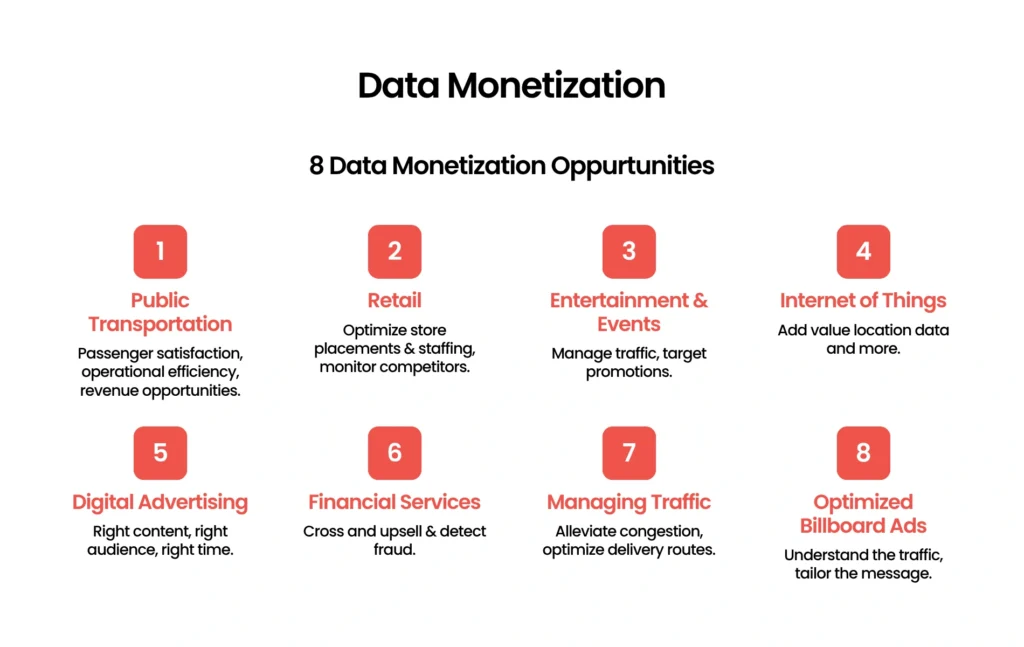
Various types of data monetization methods help companies earn profit from data analytics, which is used to enhance the overall business process efficiency.
- Internal Data Monetization: Analytics can be applied within the company in order to optimize processes, segment customers, and analyse the results in order to make the business more efficient.
- External Data Monetization: The direct earnings generated from data monetization refer to revenue that comes from selling reports, data-related products, and APIs to other companies.
- Data-Driven Service Enhancement: Businesses can use information about their customers and internal operations to improve the services/products offered, thus increasing consumer satisfaction.
- Strategic Decision Support: The planning activity of the enterprise becomes more efficient because of the insights obtained thanks to data monetization efforts.
- Innovation and Business Growth: Businesses can discover new opportunities and design new business models based on data monetization practices. [4]
Challenges in Implementing Data Monetization Strategy
There exist a number of barriers that organizations encounter when trying to implement the data monetization techniques and handle the analytical process successfully.
- Low Quality Data: Inaccurate data might distort the outcomes obtained by means of analyses.
- Data Privacy and Security Problems: Customer data has to be kept secure, hence the need to avoid any data privacy violation and associated threats.
- Challenges in Data Integration: It may be difficult to data integration from different sources and stored in separate databases.
- Shortage of Experts: Most businesses do not have enough experts in data analytics and artificial intelligence to make use of such data.
- Exorbitant Costs of Infrastructure and Technology: Expensive hardware and software solutions are essential to ensure successful implementation of data analytics processes. [5]
Conclusion
Data monetization is a practice which assists enterprises to utilize their business data effectively and derive insights that will help them make informed decisions. As digital transformation continues, the role of data analytics becomes crucial to enhance operations within an enterprise.
The right use of data analytics ensures that you understand your customers well, innovate and grow. Using good data governance strategies, security measures and data analytics techniques will help your enterprise realize the benefits of data assets.
Transform your business growth with Statswork’s Data Analytics solutions and build a smarter data monetization strategy for higher revenue.
References
- Liu, C. H., & Chen, C. L. (2015). A review of data monetization: strategic use of Big Data. https://aisel.aisnet.org/iceb2015
- Baecker, J., Engert, M., Pfaff, M., & Krcmar, H. (2020, March). Business Strategies for Data Monetization: Deriving Insights from Practice. In Wirtschaftsinformatik (Zentrale Tracks)(pp. 972-987). https://www.academia.edu/
- Wells, A. R., & Chiang, K. W. (2017). Monetizing your data: A guide to turning data into profit-driving strategies and solutions. John Wiley & Sons. https://books.google.com/book
- Parvinen, P. (2020). Advancing data monetization and the creation of data-based business models. Communications of the association for information systems, 47(1), 2. https://aisel.aisnet.org/cgi/view
- Kvalvik, P., Misra, S., Mishra, B., & Dash, S. (2026). Data as an Asset: Economic Traits, Market Dynamics, and Monetization Challenges. Wiley Interdisciplinary Reviews: Data Mining and Knowledge Discovery, 16(1), e70072. https://wires.onlinelibrary.wiley