

Improving Research Quality with Cronbach’s Alpha Reliability Testing and Data Consistency Analysis
- Home
- Insights
- Article
- Improving Research Quality with Cronbach’s Alpha Reliability Testing and Data Consistency Analysis
Qualitative Research Service
News & Trends
Recommended Reads

Data Collection
As the data collection methods have extreme influence over the validity of the research outcomes, it is considered as the crucial aspect of the studies
- 1. Introduction
- 2. DeepHealth’s Diagnostic Suite™: Revolutionizing Radiology Workflows
- 3. Key Features
- 4. AI Impact on National Screening Programs
- 5. SmartMammo™: Enhancing Breast Cancer Screening
- 6. DeepHealth AI Use Cases Across Specialties
- 7. Strategic Collaborations and Ecosystem Expansion
- 8. Impact and Adoption of DeepHealth’s AI Solutions
- 9. Conclusion: The Future of Radiology with AI
- 10. References
Introduction
Reliability and consistency are key components in collecting data and conducting research methodology since they provide a foundation for accurate analysis. The most common method used in determining the consistency of data collected in a study is called the Cronbach’s Alpha Test. It is a statistical test used by numerous scholars in various research fields such as academic studies, businesses, health, psychology, and many more to determine the reliability of survey questions.
Cronbach’s Alpha is a research tool that helps researchers find out how closely associated certain items are in a research instrument. Essentially, this method determines the reliability of several questions created with the intention of measuring the same phenomenon.
What is Cronbach’s Alpha in Simple Terms?
Cronbach’s alpha can be considered a statistical coefficient that assesses the degree of consistency between items in surveys or tests. Cronbach’s Alpha measures the level at which several questions relate to one another in terms of measuring the same concept.
To explain the concept of Cronbach’s Alpha, let’s say that a scientist developed a questionnaire measuring customer satisfaction. The items of such a questionnaire need to be consistent with each other to measure customer satisfaction correctly.
The greater the Cronbach’s Alpha, the more consistent the questions. This technique is usually used for initial research on a subject before proceeding with any further statistical calculations.
Cronbach’s Alpha Meaning in Research Methodology
Explanation of Cronbach’s Alpha is through consistency check. Reliability in research method is an assessment of stability and consistency of measurement instruments used. Where respondents give similar responses to the same question, then such measurements are said to be reliable.
Cronbach’s Alpha is often used in:
- Survey research
- Education testing
- Psychological testing
- Health care research
- Market research
- Social science research
Using Cronbach’s Alpha for checking reliability helps in identifying poor questions within the test.
Cronbach Alpha Reliability Range
There are certain standards to consider when interpreting the range of Cronbach’s Alpha Reliability. It provides an easy means for researchers to measure whether their instrument is acceptable.
- >90: Excellent
- 80 – 0.89: Good
- 70 – 0.79: Acceptable
- 60 – 0.69: Questionable
- Below 0.60: Poor/Unacceptable
A Cronbach’s Alpha value of 0.7 or above is generally considered satisfactory for most research purposes. Nonetheless, the satisfactory level may differ according to the subject area and research purpose.
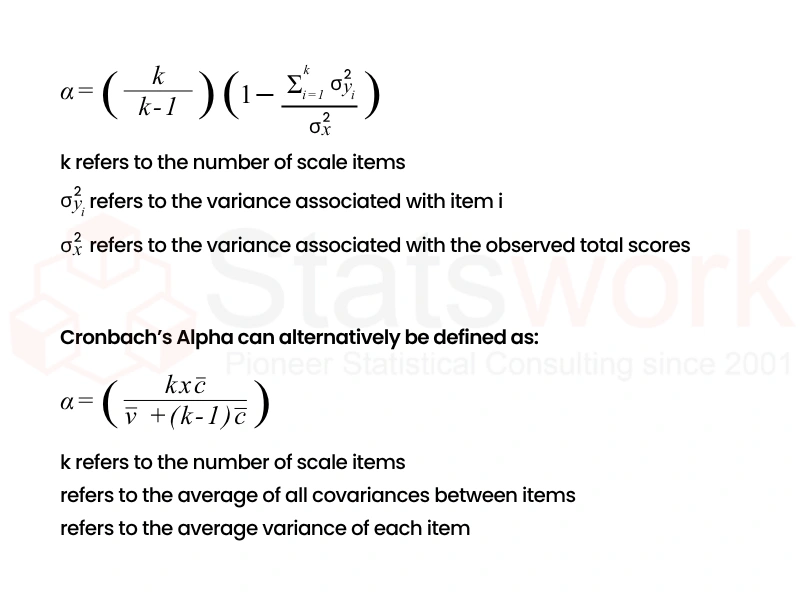
Fig 1: Cronbach’s Alpha Formula for Reliability and Internal Consistency Analysis
When to Use Cronbach’s Alpha
Statistics known as Cronbach’s Alpha are commonly applied when there is a need to assess the homogeneity of numerous variables measuring the same variable. Its primary application involves questionnaire construction and scale validation.
When should one apply Cronbach’s Alpha?
- Survey development
- Attitudinal measurement
- Behavioral analysis
- Psychological testing
- Educational assessment
- Market research study
- Research scale validation
To illustrate, in case a health care scientist constructs ten questions to gauge patient satisfaction, the Cronbach’s Alpha value will indicate how all questions measure the same construct.
It is also essential to point out that Cronbach’s Alpha works best when all items measure the same variable. When this condition is violated, Cronbach’s Alpha will be misleading.
Importance of Cronbach’s Alpha in Research Quality
The importance of Cronbach’s Alpha for research quality is essential since good data leads to valid results. Poorly structured questionnaires may yield inconsistent answers, which could affect the validity of the research results.
Reliability testing will allow researchers to do the following:
- Better questionnaire structuring
- Elimination of low-quality survey questions
- Improved data consistency
- Research integrity
- Accurate statistical analysis
Good research tools will enhance the quality of academic and professional studies. Therefore, Cronbach’s Alpha will be highly significant in research methodology and statistics.
Conclusion
Cronbach’s Alpha is one of the most important methods used for reliability test calculation. It not only defines the concept of the Cronbach’s Alpha but also shows how reliability levels can be defined and calculated by using special statistical calculators.
This statistical method is extremely useful for academic research, healthcare studies, social sciences analysis, and market analysis. It contributes to the creation of more reliable decisions made based on appropriate research results.
For professional support in Research Methodology services, reliability testing, statistical analysis, and data interpretation, connect with Statswork. Book a free consultation with Statswork to improve your research quality with expert guidance and advanced statistical solutions.
References
- Devi, Dipika, A. Dalal and Garima, “A Reliability Analysis Using Statistical Tool Cronbach’s Alpha to Investigate the Impact of Microfinance on Financial Inclusion and Self-Help Groups,” 2025 4th International Conference on Computational Modelling, Simulation and Optimization (ICCMSO), Singapore, Singapore, 2025, pp. 207-212, doi