
What is HIPAA and how is it used in data compliance?
- Home
- Insights
- Article
- What is HIPAA and how is it used in data compliance?
Qualitative Research Service
News & Trends
Recommended Reads

Data Collection
As the data collection methods have extreme influence over the validity of the research outcomes, it is considered as the crucial aspect of the studies
- 1. Introduction
- 2. DeepHealth’s Diagnostic Suite™: Revolutionizing Radiology Workflows
- 3. Key Features
- 4. AI Impact on National Screening Programs
- 5. SmartMammo™: Enhancing Breast Cancer Screening
- 6. DeepHealth AI Use Cases Across Specialties
- 7. Strategic Collaborations and Ecosystem Expansion
- 8. Impact and Adoption of DeepHealth’s AI Solutions
- 9. Conclusion: The Future of Radiology with AI
- 10. References
In today’s digital healthcare environment, organizations manage vast volumes of sensitive patient data across multiple systems. Ensuring the security, privacy, and compliance of this data is critical [1]. This is where HIPAA plays a vital role by establishing a standardized framework for healthcare data protection and compliance.
HIPAA is a standardized framework for healthcare data compliance, patient data privacy, and protection of healthcare data.
What is HIPAA in Healthcare Data Compliance
HIPAA is a federal law in the USA that was enacted in the year 1996. Its purpose is to ensure the protection of Protected Health Information. It is a federal law that dictates the rules for the handling of PHI by healthcare organizations, insurance companies, and related parties.
What is PHI?
- Personal identifiers (name, address, contact details)
- Medical records and history
- Insurance and billing information
- Lab results and diagnostic data
HIPAA ensures that healthcare data is securely managed, accessed, and transmitted across systems.
Why HIPAA is Important
HIPAA is important for healthcare data compliance in a rapidly changing digital environment.
Key Importance:
- Ensure patient data privacy and confidentiality
- Ensure HIPAA regulation compliance
- Reduce risks of data breach and cyber attacks
- Improve health information security [2]
- Establish trust between healthcare providers and patients
Non-compliance with HIPAA results in severe consequences, including financial and legal repercussions.
Where HIPAA is Used (Applications)
HIPAA is used in various healthcare systems and processes to ensure data handling is done in a secure and compliant manner.
EHR Systems
Electronic Health Records (EHR) systems use HIPAA to ensure that data is handled in a secure manner, thus promoting data security in EHR systems.
Billing & Insurance
HIPAA is used to ensure that sensitive financial and personal information used in billing and insurance is handled in a secure manner through data mapping and encryption.
Clinical Research
In a clinical research environment, HIPAA is used to ensure that data used in various studies is handled in a secure and anonymized manner in accordance with healthcare data protection standards [3].
Telemedicine
Due to the rise in telemedicine, HIPAA is used to ensure secure communication in telemedicine services.
How HIPAA Ensures Healthcare Data Compliance
HIPAA is a framework for developing a plan for HIPAA compliant data management through various mechanisms:
| Data Identification and Classification | It involves identifying and classifying data to ensure proper handling for compliance. |
| Access Control | It ensures that only authorized personnel have access to data. |
| Encryption and Security Measures | Encryption ensures security for data in transit and at rest, thus promoting HIPAA data security [4]. |
| Audit and Monitoring | It ensures that unauthorized parties do not have access to data for compliance. |
| Data Integration Standards | It promotes secure data integration healthcare to ensure that data can flow from one system to another without compromising privacy. |
Role of Data Dictionary Mapping
A vital component in ensuring that there is compliance with the HIPAA regulations is to ensure that there is consistency in data interpretation and usage. In this case, data dictionary mapping is vital.
Why It Matters:
- Data standardization
- Facilitates mapping of metadata for healthcare processes
- Facilitates accurate data mapping for healthcare
- Eliminates errors in healthcare data integration
- Enhances data governance for healthcare [5]
Data dictionary mapping is vital in enhancing data standardization healthcare and ensuring compliance with the HIPAA regulations.
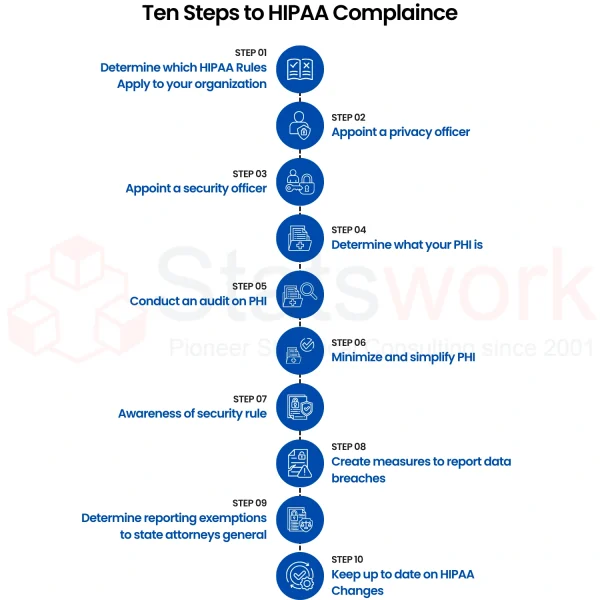
Figure 1: Key Steps in HIPAA Compliance with Healthcare Data Security and PHI Protection
Benefits of HIPAA Compliance
1. Enhanced Data Security
Ensures the security of sensitive healthcare information from unauthorized access and breaches.
2. Improved Data Governance
Improve organizational policies with a robust data governance framework.
3. Improved Interoperability
Supports healthcare data interoperability.
4. Reduced Compliance Risks
Helps minimize risks of legal and financial consequences of non-compliance.
5. Increased Patient Trust
Helps gain patient trust by having robust patient data privacy systems [3].
Challenges
Although there are benefits of HIPAA compliance, there are challenges associated with its implementation:
- Understanding HIPAA Regulations
- Integrating HIPAA with Legacy Systems
- Handling Huge Volume of Healthcare Data
- Ensuring Data Mapping of Healthcare Information
- Ongoing Monitoring of HIPAA Updates
Best Practices
To ensure effective HIPAA compliance within an organization, the following best practices must be implemented:
- Implement access control measures
- Implement encryption for data
- Implement data dictionary mapping services
- Regular audits must be conducted [4]
- Employees must be trained for compliance
- Implement a strong data governance healthcare strategy
Conclusion
The HIPAA compliance framework is an important tool for data compliance, patient data privacy, and data management. HIPAA compliance provides an opportunity for organizations to keep data safe while at the same time promoting data exchange [5].
The combination of HIPAA best practices with data dictionary mapping services provides an effective solution for data management. HIPAA is an important tool for healthcare data compliance as the healthcare sector is constantly changing.
Ready to ensure seamless HIPAA compliance and accurate data standardization?
Partner with experts in Data Dictionary Mapping Services to transform your healthcare data into secure, compliant, and interoperable systems—get a FREE consultation today!
Reference
- Chen, J. Q., & Benusa, A. (2017). HIPAA security compliance challenges: The case for small healthcare providers. International Journal of Healthcare Management, 10(2), 135-146. https://www.tandfonline.com/
- Clause, S. L., Triller, D. M., Bornhorst, C. P., Hamilton, R. A., & Cosler, L. E. (2004). Conforming to HIPAA regulations and compilation of research data. American Journal of Health-System Pharmacy, 61(10), 1025-1031. https://academic.oup.com/
- Peregrin, T. (2021). Managing HIPAA compliance includes legal and ethical considerations. Journal of the Academy of Nutrition and Dietetics, 121(2), 327-329. https://www.jandonline.org/
- Artnak, K. E., & Benson, M. (2005). Evaluating HIPAA compliance: A guide for researchers, privacy boards, and IRBs. Nursing outlook, 53(2), 79-87. https://www.sciencedirect.com/
- Schoppmann, M. J., & Sanders, D. L. (2004). HIPAA compliance: The law, reality, and recommendations. Journal of the American College of Radiology, 1(10), 728-733. https://www.sciencedirect.com/