
What is Python and what makes it Unique
- Home
- Insights
- Article
- What is Python and what makes it Unique
Qualitative Research Service
News & Trends
Recommended Reads
Data Collection
As the data collection methods have extreme influence over the validity of the research outcomes, it is considered as the crucial aspect of the studies
- 1. Introduction
- 2. DeepHealth’s Diagnostic Suite™: Revolutionizing Radiology Workflows
- 3. Key Features
- 4. AI Impact on National Screening Programs
- 5. SmartMammo™: Enhancing Breast Cancer Screening
- 6. DeepHealth AI Use Cases Across Specialties
- 7. Strategic Collaborations and Ecosystem Expansion
- 8. Impact and Adoption of DeepHealth’s AI Solutions
- 9. Conclusion: The Future of Radiology with AI
- 10. References
Python
Python is a general-purpose, high-level programming language created by Guido van Rossum and initially made public in 1991. Python programming language is easy to read and write, making it popular for beginners and experienced developers alike.
The design philosophy of Python allows for less complexity in the source code while allowing the programmer to communicate concepts with fewer lines of code when compared to other languages such as Java or C++.
What Makes Python Unique
Readable and Simple Syntax
- Clean, simple, and straightforward syntax is one of the many things that make Python such a wonderful programming language.
- Because its basic format is very similar to how people speak English, anyone who has ever had trouble learning to program will find it much easier to use Python.
- Writers can concentrate on the problem they are trying to solve instead of having to worry about the details of writing complex code.
Interpreted and Dynamically Typed
- Python is an interpreted programming language; therefore, it executes code line-by-line and facilitates debugging or testing.
- Because it’s dynamically typed, variable types are known only during execution time.
- Being flexible creates an increasingly rapid development cycle for developers along with the ability to create prototype applications quickly.
Extensive Standard Library
- Python is based on a rich set of libraries (modules) for many kinds of programming, including handling files, creating websites, analyzing data, etc.
- By providing a rich standard library, the need for custom coding to accomplish tasks is greatly reduced, and development is much faster.
Cross-Platform Compatibility
- Python runs on multiple platforms. Examples include Windows, macOS, Linux
- Due to its portability, the same code can run on multiple platforms without needing to modify.
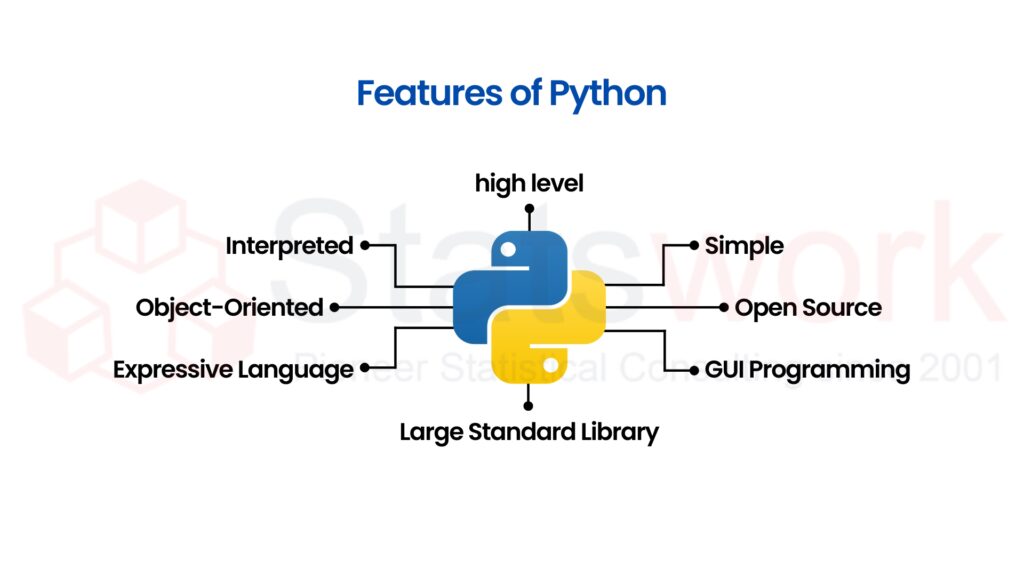
Fig 1 shows the A visual summary of Python’s key features and capabilities.
Supports Multiple Programming Paradigms
- Python is adaptable to your project’s needs because of its support for object-oriented, procedural, and functional programming.
Large Community and Ecosystem
- The widespread acceptance of Python and its extensive global developer network continue to expand with a multitude of libraries and frameworks, including NumPy, Pandas, TensorFlow, and Flask.
- As a result, there are many avenues for developers to locate various forms of support and solutions while developing software.
Integration Capabilities
- Not only does Python support seamless integration of other programming languages (C, C++, and Java).
- It provides direct access to data and services via the use of APIs, databases, and Cloud services.
In summary,
Python is a well-rounded programming language that has many applications by offering its simplicity, flexibility, and comprehensive libraries.
Python’s ease of use and versatility make it a strong choice for many users and have helped contribute to its status as one of the most popular programming languages.
From prediction to performance—StatsWork AI & ML Services power your next move.
References
- Van Rossum, G., & Drake, F. L. (2003). An introduction to Python(p. 115). Bristol: Network Theory Ltd. http://atk.fam.free.fr/fichiers/stage/Python/JF/site/pytut.pdf
- Van Rossum, G., & Drake, F. L. (1995, April). Python library reference. https://cz8023.cn/book/book/python/library.pdf
- Sanner, M. F. (1999). Python: a programming language for software integration and development. J Mol Graph Model, 17(1), 57-61. https://d1wqtxts1xzle7.cloudfront.net/25505223/10.1.1.35.6459-libre.pdf?1390869360=&response-content-