
What does Data-Informed Storytelling mean?
- Home
- Insights
- Article
- What does Data-Informed Storytelling mean?
Qualitative Research Service
News & Trends
Recommended Reads
Data Collection
As the data collection methods have extreme influence over the validity of the research outcomes, it is considered as the crucial aspect of the studies
- 1. Introduction
- 2. DeepHealth’s Diagnostic Suite™: Revolutionizing Radiology Workflows
- 3. Key Features
- 4. AI Impact on National Screening Programs
- 5. SmartMammo™: Enhancing Breast Cancer Screening
- 6. DeepHealth AI Use Cases Across Specialties
- 7. Strategic Collaborations and Ecosystem Expansion
- 8. Impact and Adoption of DeepHealth’s AI Solutions
- 9. Conclusion: The Future of Radiology with AI
- 10. References
Today’s organizations require more than just data; they require insights that lead to action. Through the application of Data Informed Storytelling, results from analysis are converted into understandable and interpretable stories that tell what happened, why it happened, and what should happen next. Data Informed Storytelling bridges the gap between data and the real world by ensuring that insights are understandable, credible, and actionable.[1]
The Strategic Importance of Context in Data Analysis
- Raw data is seldom acted upon without context or explanation.
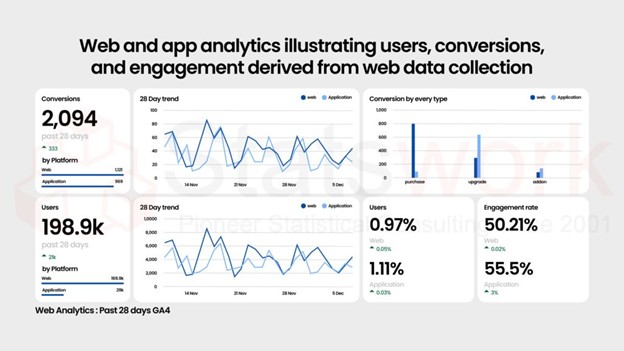
- Charts, tables, and dashboards are used to show trends, but they do not explain what those trends mean.
- Data-Driven storytelling adds context, meaning, and explanation to data insights.
- Emphasizing interpretation over observation helps to explain the “why” behind the data.
- Data storytelling enables information to become understanding, which leads to informed decision-making and actionable outcomes.[2]
How Data Stories Enable Better Decisions
Data storytelling service is an effective way for organizations to make informed decisions by reducing complexity and uncertainty. When data insights communications are framed in a structured story:
- Trends are explained, not just displayed: Data exhibits patterns with proper context and meaning.
- Causes and implications become easier to identify: Data insights uncover reasons for occurrences and their effects.
- Decisions are supported by evidence, not assumptions: Decisions are based on information, not assumptions.
- Engagement across audiences: Technical and non-technical teams can make decisions based on insights with confidence.[3]
Major Elements of an Effective Data Story
Good data stories have some key elements in common:
- Clear narrative flow: The findings are structured in a logical way, from problem or question to solution.
- Relevant context: The data is interpreted in the context of the business or market environment in which the decisions are made.
- Purpose-driven visuals: The visualizations are used to reinforce the point, not to overwhelm the audience.
- Actionable outcomes: Each story leads to a conclusion, recommendation, or next step.
These key elements help keep the focus of data storytelling on impact, not presentation.[4]
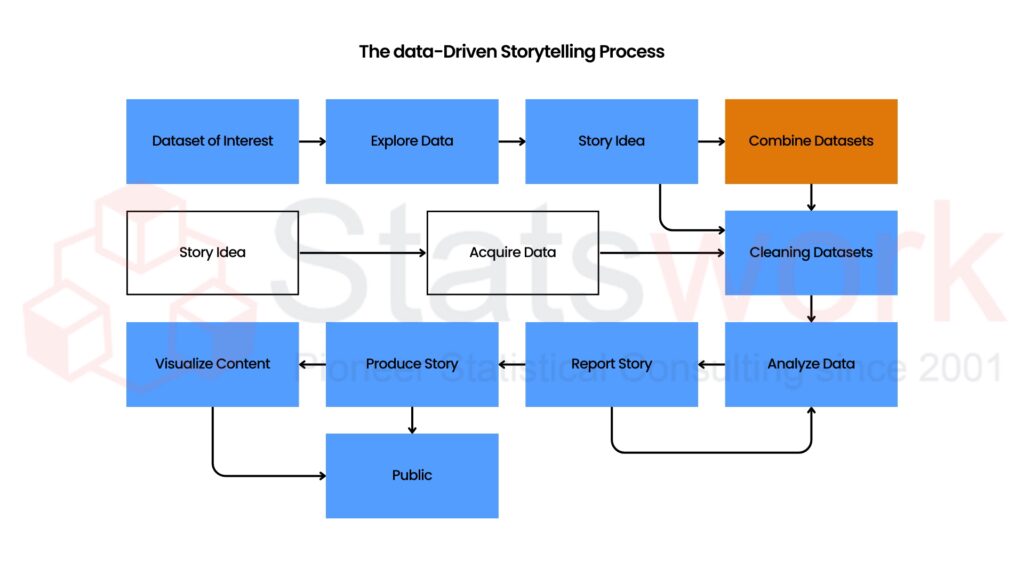
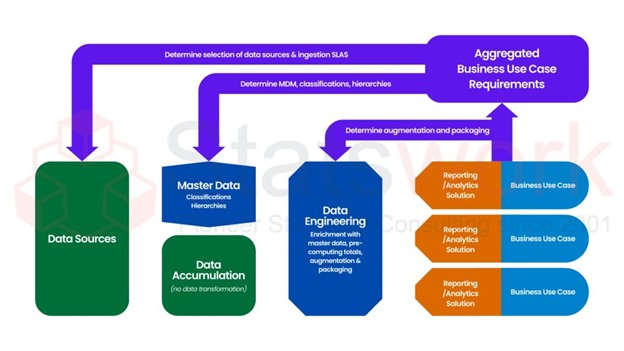
Fig 1 shows the data-driven storytelling process from data exploration to publishing insights.
Where Data Storytelling Creates Organizational Value
Storytelling with data is an important part of various activities in organizations:
Business Function | Value of Data Storytelling |
Executive Reporting | Allows strategic decisions to occur faster and clearer. |
Marketing Analytics | Provides explanations of performance, customer behaviour, and the impact of campaigns. |
Product Strategy | Allows the identification of trends, risks, and opportunities for improvement. |
Operations | Identifies inefficiencies and highlights areas for optimization. |
Overall Impact | Provides the ability to ensure that insights are understood, trusted, and used effectively.[5] |
In Conclusion, Data storytelling technique is the process of turning data into a compelling story that drives action and clarity. It involves the use of insights, context, and purpose to help organizations explain trends, identify causes, and make decisions. This is important because it ensures that information is not only accurate but also understandable, credible, and actionable, which enables teams to make informed decisions in all business functions.
Transform your raw data into actionable narratives—StatsWork’s Thoughtful Leadership makes insights work for you!
Reference
- McDowell, K., & Turk, M. J. (2024). Teaching data storytelling as data literacy. Information and Learning Sciences, 125(5/6), 321-345. https://www.emerald.com/insight/content/doi/10.1108/ils-06-2023-0068/full/html
- Auron, M., Amin, A. N., Brooks, M. N., & Sata, S. S. (2025). Storytelling: How to Make Data Meaningful?. Medical Clinics, 109(5), 969-980. https://www.medical.theclinics.com/article/S0025-7125(25)00033-1/abstract
- Dykes, B. (2019). Effective data storytelling: how to drive change with data, narrative and visuals. John Wiley & Sons. https://books.google.com/books?hl=en&lr=&id=rHDDDwAAQBAJ&oi=fnd&pg=PR9&dq=How+Data+Stories+Enable+Better
- Borges, M., Correa, C. M., & Silveira, M. S. (2022). Fundamental elements and characteristics for telling stories using data. Journal on Interactive Systems, 13(1), 77-86. https://journals-sol.sbc.org.br/index.php/jis/article/view/2330
- Boldosova, V., & Luoto, S. (2020). Storytelling, business analytics and big data interpretation: Literature review and theoretical propositions. Management Research Review, 43(2), 204-222. https://www.emerald.com/insight/content/doi/10.1108/MRR-03-2019-0106/full/html