
What is the Sample Size in Simple Terms?
- Home
- Insights
- Article
- What is the Sample Size in Simple Terms?
Qualitative Research Service
News & Trends
Recommended Reads

Data Collection
As the data collection methods have extreme influence over the validity of the research outcomes, it is considered as the crucial aspect of the studies
- 1. Introduction
- 2. DeepHealth’s Diagnostic Suite™: Revolutionizing Radiology Workflows
- 3. Key Features
- 4. AI Impact on National Screening Programs
- 5. SmartMammo™: Enhancing Breast Cancer Screening
- 6. DeepHealth AI Use Cases Across Specialties
- 7. Strategic Collaborations and Ecosystem Expansion
- 8. Impact and Adoption of DeepHealth’s AI Solutions
- 9. Conclusion: The Future of Radiology with AI
- 10. References
To save time and money, research studies commonly use small samples to reflect a larger population. For practical use, sample size is the main factor used to determine accuracy of the results to reality. The more the number of observations taken will give you a clearer picture of the overall system, much like tasting some spoonfuls of a pot of soup helps you get a complete idea of what the complete soup tastes like.[1]
Population vs Sample
Population: A population refers to the complete collection of people or things that a researcher wants to research. For example, all the students at a university.
Sample: A sample is a small portion of the population that is selected to be able to be analyzed. An example is 200 students from a university’s total of 5,000 students.
Sample size: The sample size is the total number of observations made in the sample. The sample size will help to define how reliable and accurate the study’s findings will be.[2]
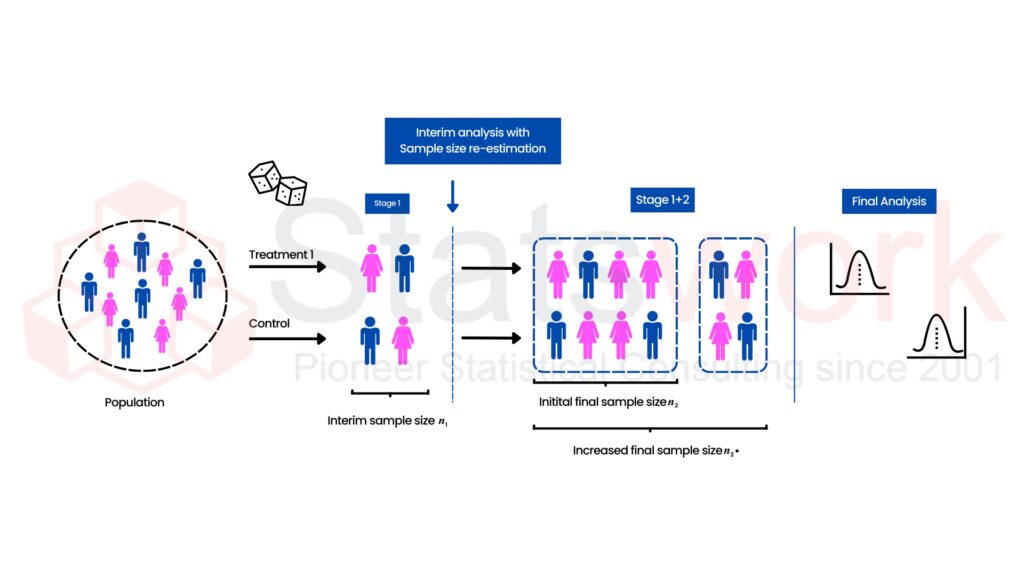
Fig 1 shows the process of determining and adjusting sample size in stages, from the initial analysis to the final analysis.
Sample Size and Statistical Accuracy
Aspect | Description |
Accuracy | A bigger sample will be a more accurate representation of the population, thus reducing potential error and bias. |
Reliability | Providing a consistent and solid foundation for analysis and conclusions. |
Statistical Validity | Adequate sample size allows for valid statistical tests and inferences. |
Decision Confidence | A bigger sample will provide greater confidence when making data-based decisions. |
Cost and Time Balance | Properly sized samples will provide a balance of accuracy with respect to the amount of time, budget, and other resources available.[3] |
Factors Affecting Sample Size
Population Size: For large populations, this means more samples are needed, and it may become less effective as the population gets larger.
Margin of Error: If you want the least acceptable error, use a larger sample size.
Confidence Level: To achieve a high confidence level, larger samples are necessary to accurately represent these populations.
Variability: A very diverse population will require more samples so that you can accurately depict any differences between groups.
Conclusion
Sample size is an important aspect of research. If your sample size is too small, your results may not be valid; if it’s too large, you’ll waste valuable time and resources on the research process.
To maximize the accuracy, reliability, and efficiency of their research findings, researchers must determine the appropriate sample size through statistical calculations. The goal of determining sample sizes is to provide valid and representative results for the population being studied.[5]
Work Smarter Across Every Trial Phase with StatsWork Statistical Expertise
Reference
- Morse, J. M. (2000). Determining sample size. Qualitative health research, 10(1), 3-5. https://journals.sagepub.com/doi/abs/10.1177/104973200129118183
- Kazerooni, E. A. (2001). Population and sample. American Journal of Roentgenology, 177(5), 993-999. https://ajronline.org/doi/full/10.2214/ajr.177.5.1770993
- Biau, D. J., Kernéis, S., & Porcher, R. (2008). Statistics in brief: the importance of sample size in the planning and interpretation of medical research. Clinical orthopaedics and related research, 466(9), 2282-2288. https://link.springer.com/article/10.1007/s11999-008-0346-9
- Lakens, D. (2022). Sample size justification. Collabra: psychology, 8(1), 33267. https://online.ucpress.edu/collabra/article/8/1/33267/120491/Sample-Size-Justification