
What is Genome-Wide Association Studies (GWAS)?
- Home
- Insights
- Article
- What is Genome-Wide Association Studies (GWAS)?
Qualitative Research Service
News & Trends
Recommended Reads

Data Collection
As the data collection methods have extreme influence over the validity of the research outcomes, it is considered as the crucial aspect of the studies
- 1. Introduction
- 2. DeepHealth’s Diagnostic Suite™: Revolutionizing Radiology Workflows
- 3. Key Features
- 4. AI Impact on National Screening Programs
- 5. SmartMammo™: Enhancing Breast Cancer Screening
- 6. DeepHealth AI Use Cases Across Specialties
- 7. Strategic Collaborations and Ecosystem Expansion
- 8. Impact and Adoption of DeepHealth’s AI Solutions
- 9. Conclusion: The Future of Radiology with AI
- 10. References
Genome-wide studies have completely changed the paradigm of understanding complex traits and diseases by allowing the entire genome to be analysed for variation. Genome-Wide Association Studies are a type of study that involves analysing DNA in large groups of people to look for associations between DNA variations and certain traits. This allows millions of markers to be analysed at the same time and is used in modern genetic association studies.[1]
Research Design and Analytical Workflow
A robust framework is necessary for the generation of authentic and meaningful outcomes. The standardized GWAS methodology, aided by the GWAS analysis, is necessary for accuracy, reproducibility, and authenticity of the results of genetic associations.
- Step 1: Selection of Study Populations: Carefully selected cases and controls are identified for the accurate genetic comparison.
- Step 2: Genome-Wide Genotyping: Millions of SNPs are tested to scan the entire genome for genetic variation associated with traits.
- Step 3: Data Quality Control: Low-quality samples and non-reliable genetic markers are removed to eliminate inaccuracies and noise in the data.
- Step 4: Statistical Association Testing: Appropriate models are used to detect significant associations between genetic variations and traits.
- Step 5: Result Validation and Interpretation: The associations are tested for biological plausibility to authenticate meaningful and authentic outcomes.[2]
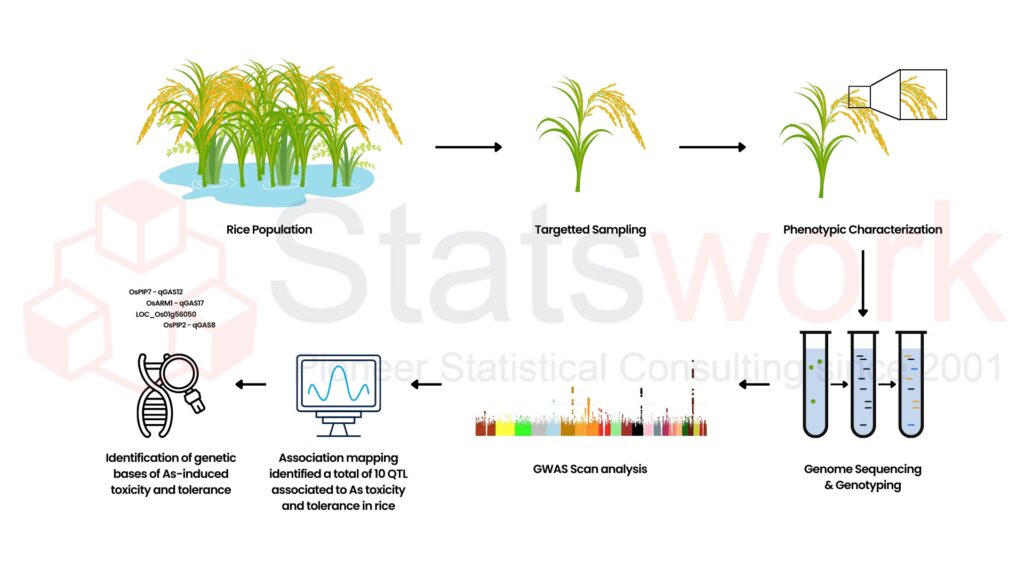
Fig. 1 shows the GWAS process in rice, from sampling and genotyping to association mapping and identifying genetic traits.
Core Elements of the Analytical Framework
A strong analytical framework provides accurate and meaningful outcomes for genome-wide analysis.
- Study Population: Large and well-annotated populations enhance the power of statistical analysis and facilitate accurate comparisons.
- Genetic Markers: Genome-wide SNPs provide strong support for accurate SNP association analysis and capture genetic variation.
- Statistical Models: Regression and correction techniques provide control over bias and multiple testing.
- Data Validation: Validation of results in separate datasets provides confirmation of accuracy.
- Interpretation: Biological analysis provides meaningful interpretation of results, facilitating accurate GWAS data analysis.[3]
Interpreting Genetic Signals and Results
These analyses reveal associations between genetic variants and traits, and genetic association studies are a key component in the discovery of underlying biological mechanisms.
Aspect | Description |
Initial Identification | Genetic associations are the starting point for understanding complex traits. |
Biological Context | Genetic variants can indicate regions of pathways rather than genes |
Correlation vs Causation | Genetic associations are indicative of correlation and not causation. |
Functional Impact | Genetic variants can affect gene regulation or expression rather than gene structure. |
Validation | Functional studies are necessary for confirmation of genetic associations and their appropriate use.[4] |
Impact on Medical and Disease Research
The application of GWAS in disease research has revolutionized modern medicine by enhancing disease prediction and therapeutic development. GWAS analysis aids in the identification of genetic susceptibility loci for complex diseases like diabetes, cardiovascular diseases, autoimmune disorders, and cancer.
Major contributions include:
- Identification of disease susceptibility genes
- Support for precision medicine and risk stratification
- Guidance for drug target discovery and development
As technology advances, the use of genome-wide analysis is increasing in the development of personalized and preventive medicine.[5]
In conclusion, genetic association studies are very important in identifying key genetic variants, increasing our knowledge of complex traits, and offering important insights that can inform research and improve disease prediction and personalized healthcare.
Elevate your research with StatsWork’s Biostatistics—precision, clarity, and results in one.
Reference
- Uffelmann, E., Huang, Q. Q., Munung, N. S., De Vries, J., Okada, Y., Martin, A. R., … & Posthuma, D. (2021). Genome-wide association studies. Nature Reviews Methods Primers, 1(1), 59. https://www.nature.com/articles/s43586-021-00056-9
- Sale, M. M., Mychaleckyj, J. C., & Chen, W. M. (2009). Planning and executing a genome wide association study (GWAS). In Molecular Endocrinology: Methods and Protocols(pp. 403-418). Totowa, NJ: Humana Press. https://link.springer.com/protocol/10.1007/978-1-60327-378-7_25
- Uitterlinden, A. G. (2016, July). An introduction to genome-wide association studies: GWAS for dummies. In Seminars in reproductive medicine(Vol. 34, No. 04, pp. 196-204). Thieme Medical Publishers. https://www.thieme-connect.com/products/ejournals/html/10.1055/s-0036-1585406
- Pers, T. H. (2016). Gene set analysis for interpreting genetic studies. Human molecular genetics, 25(R2), R133-R140. https://academic.oup.com/hmg/article-abstract/25/R2/R133/2198220
- Hakonarson, H., & Grant, S. F. (2011). Genome‐wide association studies (GWAS): impact on elucidating the aetiology of diabetes.Diabetes/metabolism research and reviews, 27(7), 685-696. https://onlinelibrary.wiley.com/doi/abs/10.1002/dmrr.1221