
What is SQL Data Mining?
- Home
- Insights
- Article
- What is SQL Data Mining?
Qualitative Research Service
News & Trends
Recommended Reads
Data Collection
As the data collection methods have extreme influence over the validity of the research outcomes, it is considered as the crucial aspect of the studies
- 1. Introduction
- 2. DeepHealth’s Diagnostic Suite™: Revolutionizing Radiology Workflows
- 3. Key Features
- 4. AI Impact on National Screening Programs
- 5. SmartMammo™: Enhancing Breast Cancer Screening
- 6. DeepHealth AI Use Cases Across Specialties
- 7. Strategic Collaborations and Ecosystem Expansion
- 8. Impact and Adoption of DeepHealth’s AI Solutions
- 9. Conclusion: The Future of Radiology with AI
- 10. References
In the modern online world, SQL data mining is a highly efficient way to discover patterns that may be hidden within large databases. Using structured querying through SQL and analytical tools uniquely allows you to deliver predictive and descriptive insights to users, without having to transfer the actual data from one platform to another.
Preparing Data for Analysis
Clean and formatted data is essential for getting precise information possible. Proper preparation will create reliable results.
- Data Cleaning: To delete duplicates or handle missing values create a mining data in SQL Server.
- Data Transformation: Raw data sets should be formatted for proper modeling and analysis.
- Aggregation and Summarization: SQL queries can be used to efficiently summarize and group your information.
- Foundation for Analysis: Properly formatted data also creates accurate SQL data analysis and results.
Techniques for Pattern Discovery
Finding patterns in data can provide information on trends and behaviors. Some of the ways that this is done include:
- Clustering: Grouping data to find customer segments or product groups.
- Association Rules: Finding products that are often purchased together for market basket analysis.
- Regression Analysis: Predicting numerical outcomes, such as sales or demand, based on past data.
Using data mining with SQL, these tasks can be completed in the database, reducing data movement and increasing the speed of the analysis.[2]
Comparison of Analytical Methods
Method | Benefit | Example Use Case |
Clustering | Identifies opportunities for targeted marketing | Categorizing customers based on purchasing behavior |
Classification | Enhances the accuracy of decision-making | Calculating the chances of loan approval |
Regression | Aids planning and budgeting | Estimates sales revenue |
Association | Improves cross-selling plans | Market basket analysis |
This table illustrates how various methods offer insights and assist in using SQL for predictive data analysis.[3]
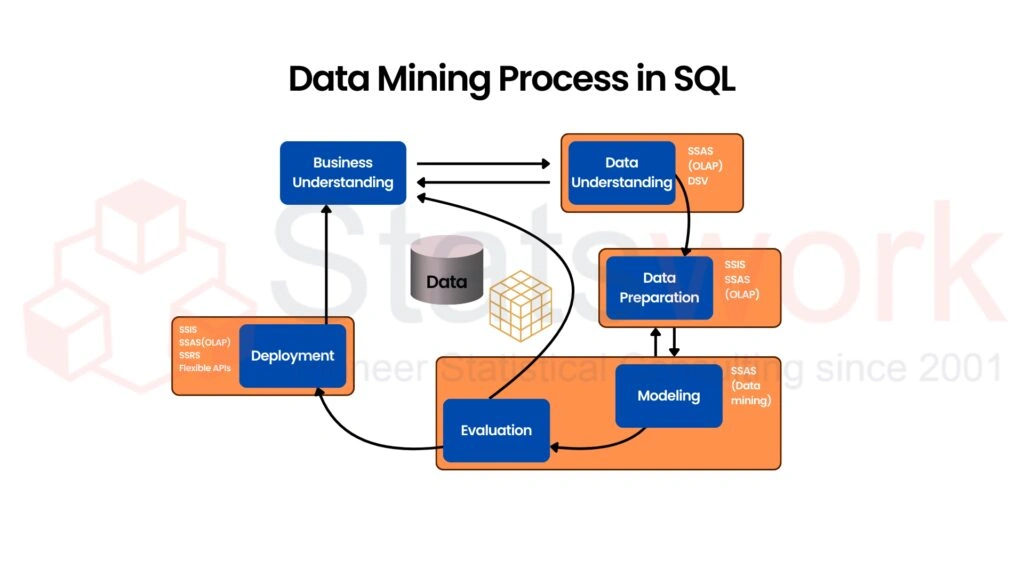
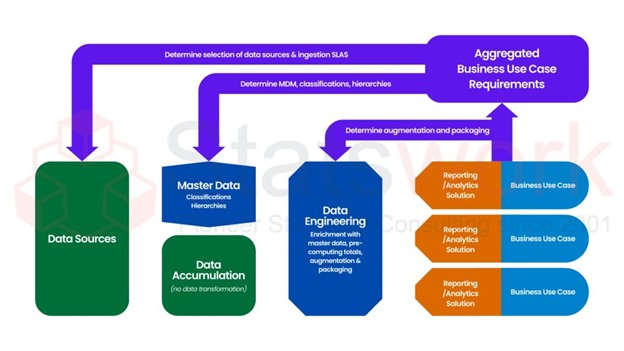
Fig 1 shows the end-to-end SQL data mining process from data understanding to modelling, evaluation, and deployment.
Implementing Models in SQL
After the data preparation and pattern identification, models can be developed directly within SQL databases. This makes predictive analysis easier and secures the data.
- Model Integration: Use machine learning models or built-in functions by SQL database mining.
- Predictive Analysis: Make predictions on trends or classify results directly in the database.
- Efficiency and Security: Do not transfer data to other applications, making analysis secure and faster.[3]
Best Practices for Successful Mining
There are a few SQL Data Mining best practices you should adopt to maximize your value:
- Keep your Queries optimized and able to process large datasets in an efficient manner.
- Keep validating your models with new data to ensure that your models are still accurate.
- Keep a record of any transformations and assumptions made to allow for easy reproducibility.
- Use Index and Database Specific features to help improve your performance.[4]
Driving Insights from Predictive Analysis
The primary objective of SQL analysis is to convert data into insights that help in decision-making.
- Trend Forecasting: Utilize SQL predictive data analysis to forecast future trends and results.
- Risk Identification: Identify possible risks and anomalies from the insights of the database.
- Informed Decision-Making: Facilitate strategic decision-making based on facts rather than assumptions.
- Maximizing Data Value: SQL data mining allows organizations to tap into the full potential of their relational databases without the aid of other software.
Thus, SQL data mining enables organizations to unlock the power of data to make informed decisions. SQL database mining and predictive analysis help organizations predict trends, risks, and make informed decisions efficiently and securely.
Transform your data into actionable insights—experience StatsWork’s Data Mining expertise and drive smarter, faster decisions today!
Reference
- Sidló, C. I., & Lukács, A. (2005, October). Shaping SQL-based frequent pattern mining algorithms. In International Workshop on Knowledge Discovery in Inductive Databases(pp. 188-201). Berlin, Heidelberg: Springer Berlin Heidelberg. https://link.springer.com/chapter/10.1007/11733492_11
- Trueblood, R. P., & Lovett, J. N. (2001). Data Mining and Statistical Analysis Using SQL(Vol. 1). Berkeley, CA: Apress. https://link.springer.com/content/pdf/10.1007/978-1-4302-0855-6.pdf
- Martins, L. (2019). Challenges and opportunities for a successful mining industry in the future. Boletín geológico y Minero, 130(1), 99-121. https://repositorio.ulisboa.pt/handle/10451/53949