
What is Neural Network development?
- Home
- Insights
- Article
- What is Neural Network development?
Qualitative Research Service
News & Trends
Recommended Reads
Data Collection
As the data collection methods have extreme influence over the validity of the research outcomes, it is considered as the crucial aspect of the studies
- 1. Introduction
- 2. DeepHealth’s Diagnostic Suite™: Revolutionizing Radiology Workflows
- 3. Key Features
- 4. AI Impact on National Screening Programs
- 5. SmartMammo™: Enhancing Breast Cancer Screening
- 6. DeepHealth AI Use Cases Across Specialties
- 7. Strategic Collaborations and Ecosystem Expansion
- 8. Impact and Adoption of DeepHealth’s AI Solutions
- 9. Conclusion: The Future of Radiology with AI
- 10. References
The process of developing Neural Networks consists of developing Neural Networks similar in structure to how the Human Brain was designed. Neural Networks are a fundamental component of AI & Machine Learning; they learn patterns through training data, the ability to learn from new input data, and the ability to provide an advanced capability for Machine Learning Applications such as Image Recognition, Speech Recognition, Fraud Detection, and Predictive Analytics.[1]
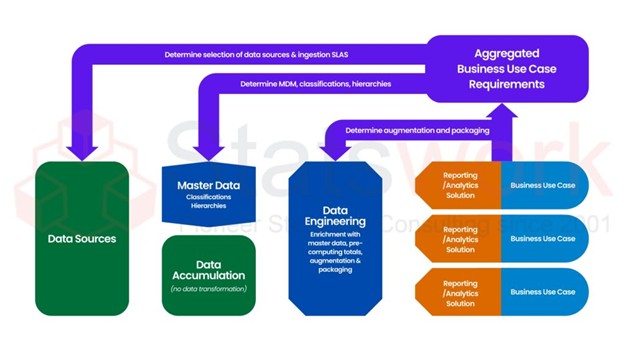
Stages of Neural Network Development
Step 1: Problem Definition
Defining both goals and objectives as well as what will be measured for success.
Step 2: Data Preparation
Gathering all relevant data (including any necessary cleaning) and converting it into useable format.
Step 3: Model Design
Deciding upon Network design with required parameters.
Step 4: Training
Discovering patterns through changing weights of the network by utilizing various methodologies for optimization.
Step 5: Evaluation and Optimization
Evaluating and improving performance of Network Model.
Step 6: Deployment and Monitoring
Apply the Model in practice and continually monitor performance.[2]
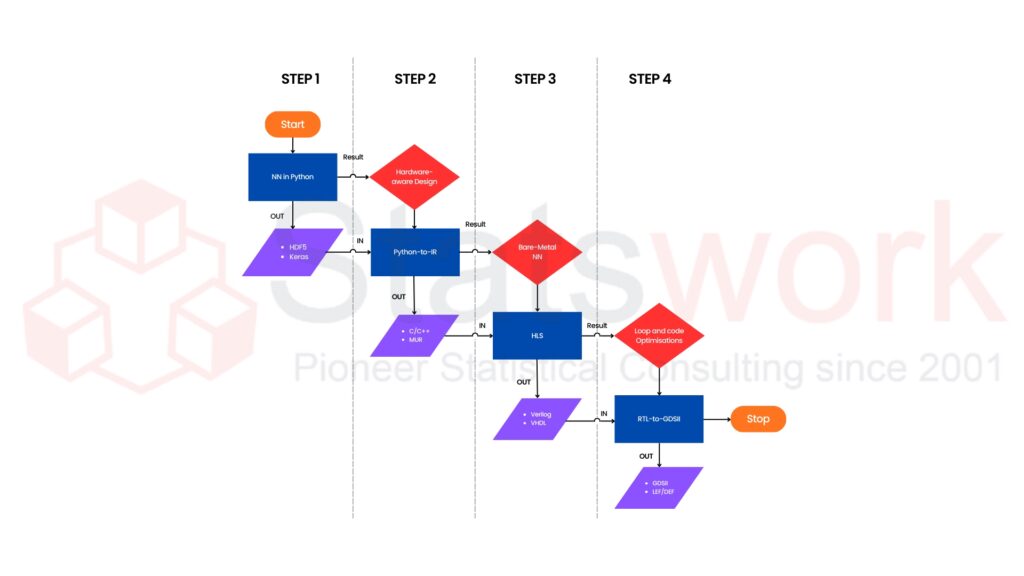
Types of Neural Networks
- Feedforward Neural Networks (FNNs): Classifications/regressions are examples of the basic network structure that receives one-way data flow.
- Convolutional Neural Networks (CNNs): Specialized Deep Learning networks for following spatial patterns in images/videos.
- Recurrent Neural Networks (RNNs): Networks are designed to work with sequential data by adding memory capabilities to sequence/time-based information, including speech/text.
- Long Short-Term Memory Networks (LSTMs): An Enhanced Recurrent Neural Network (RNN) capable of effectively working with long-range dependencies in sequences.[3]
- Gated Recurrent Units (GRUs): A fast and simple version of the Long Short-Term Memory (LSTM) network which uses much fewer parameters and offers comparable performance.
- Radial Basis Function Networks (RBFNs): Generalized Learning methods for Function Approximation, Regression, and Pattern Recognition.
- Self-Organizing Maps (SOMs): Unsupervised networks – Clustering, data visualization and dimensionality reduction via unsupervised networks.
- Deep Belief Networks (DBNs): Deep architecture is something learned while using unsupervised pre-training methods.
- Generative Adversarial Networks (GANs): A two-model architecture (generator-model and discriminator-model) for generating realistic synthetic data.
- Autoencoders (AEs): Common applications of Denoising Autoencoders (DAs) include data compression, noise removal, Dimensionality Reduction, and Anomaly Detection.
- Transformer Networks: Self-Attention Mechanisms in NLP: High-Performance Models for Translation and Text Generation.
- Siamese Neural Networks: Similarity Analysis Networks compare two input items for their degree of similarity, commonly used in facial recognition and verification.
- Capsule Networks (CapsNets): A form of networks that can grasp spatiotemporal hierarchies and relationships between parts to whole structure in images.
- Spiking Neural Networks (SNNs): Models developed from Neural Structure (i.e., brain-inspired) for neuromorphic functions and biological simulations.[4]
Applications and Challenges of Neural Networks:
Aspect | Application | Challenges |
Computer Vision | Recognition of images, medical imaging, object recognition | Large data sets and powerful computing resources are required. |
Natural Language Processing | Machine translation, conversational agents, analysis of sentiment. | Difficult for machines to understand terms, context and cultural nuances. |
Finance | Detection of fraudulent activity, assigning credit scores, trade execution through algorithms. | Maintaining transparency, minimizing bias, compliant with regulations. |
Manufacturing & Industry | Predictive maintenance, inspection of goods. | Ability to Integrate into existing systems with real time capability. |
Retail & E-commerce | Systems for recommended products and services, analysis of user behaviour. | The challenge of scaling and accommodating new users (cold-start effect) |
Empower Your Digital Transformation with StatsWork AI & ML Services.
Reference
- Gurney, K. (2018). An introduction to neural networks. CRC press. https://www.taylorfrancis.com/books/mono/10.1201/9781315273570/introduction-neural-networks-kevin-gurney
- Wu, Y. C., & Feng, J. W. (2018). Development and application of artificial neural network. Wireless Personal Communications, 102(2), 1645-1656. https://link.springer.com/article/10.1007/s11277-017-5224-x
- Sharkawy, A. N. (2020). Principle of neural network and its main types. Journal of Advances in Applied & Computational Mathematics, 7, 8-19. https://www.avanti-journals.com/index.php/jaacm/article/view/851
- https://onlinelibrary.wiley.com/doi/full/10.1155/2022/5416722 https://www.avanti-journals.com/index.php/jaacm/article/view/851
- Katal, A., & Singh, N. (2021). Artificial neural network: models, applications, and challenges. Innovative trends in computational intelligence, 235-257. https://link.springer.com/chapter/10.1007/978-3-030-78284-9_11