


What is the Concept of Java?
- Home
- Insights
- Article
- What is the Concept of Java?
Qualitative Research Service
News & Trends
Recommended Reads

Data Collection
As the data collection methods have extreme influence over the validity of the research outcomes, it is considered as the crucial aspect of the studies
- 1. Introduction
- 2. DeepHealth’s Diagnostic Suite™: Revolutionizing Radiology Workflows
- 3. Key Features
- 4. AI Impact on National Screening Programs
- 5. SmartMammo™: Enhancing Breast Cancer Screening
- 6. DeepHealth AI Use Cases Across Specialties
- 7. Strategic Collaborations and Ecosystem Expansion
- 8. Impact and Adoption of DeepHealth’s AI Solutions
- 9. Conclusion: The Future of Radiology with AI
- 10. References
Java is a high-level, object-oriented programming language designed to be platform agnostic and provide a stable and secure environment for developing applications. With the motto “Write Once, Run Anywhere,” applications developed in Java can run on any machine running a Java Virtual Machine (JVM). Applications developed using Java are utilized across many industries and applications, such as: Enterprise, Mobile, Web, Large Scale Applications.[1]
Fundamental Principles of Java Programming
Object-Oriented Programming (OOP): Java has class and object encapsulation, inheritance, polymorphism and abstraction to promote reuse of code.
Platform Independence: Any computer can run Java programs with JVM.
Java Virtual Machine (JVM): Run Java bytecode by running memory usage for it and securing your application via Java.
Automatic Memory Management: Auto-removes unused objects by using the garbage collection process to free up some memory space.
Security: Bytecode verification ensures safe execution by avoiding direct pointer access.
Multithreading: Java multithreading Allows multiple tasks to execute concurrently, which improves system performance and responsiveness.
Rich Standard Library: Provides many built-in Application Programming Interfaces (APIs) that allow programmers to quickly and easily perform common tasks frequently encountered in programming.[2]
Java Virtual Machine (JVM)
- Java Virtual Machine provides the ability to execute Java code on any platform independent of Operating Systems.
- It makes the Java bytecode executable by converting it into machine-specific executable software.
- It is responsible for allocating system memory, conducting Garbage Collect (removing unneeded) and managing Threads.
- It enables Java’s Runtime Security by examining the bytecode before execution.
- It allows the Java Code to be Executed Cross-Platforms and Hardware since the Code Does Not Change.[3]
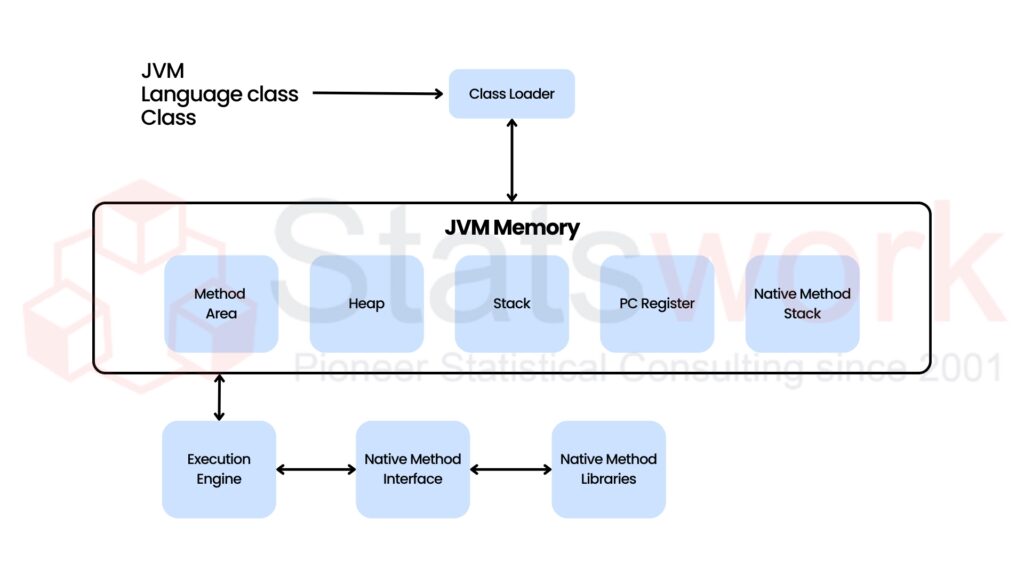
Fig 1 shows the architecture of the Java Virtual Machine (JVM) and its main components.
Platform Independence
- Definition: Platform independence refers to the ability of Java applications to run on all operating systems without modification.
- Bytecode Compilation: Java source code is compiled into bytecode, not machine specific code.
- JVM Requirement: Bytecode may run on Windows, Linux or macOS, if there exists a compatible Java Virtual Machine (JVM).
- Portability: Application movement between systems is easy.
- Reduced Effort: A developer will write the code one time and deploy it on multiple platforms.
Security and Robustness in Java
Aspect | Description |
Security Features | Security features integrated into Java are appropriate for networked applications |
No Pointer Usage | Pointer access via direct references is prohibited in Java, therefore reducing the risk of memory corruption |
Bytecode Verification | Before executing bytecode, Java checks it to ensure it does not contain any malicious code. |
Strong Type Checking | Java guarantees data type safety at both compile and execution time. |
Exception Handling | Java manages runtime errors, so they don’t cause application crashes. |
Runtime Checks | Java detects and handles all errors that occur during execution. |
Result | Java provides reliable and secure applications with consistent application performance.[4] |
Java in Practical Computing
- Web Applications: To create safe web-based apps and scalable web-based apps.
- Enterprise Applications: The most common applications are banking, enterprise resource planning project (ERP), and large company software systems.
- Mobile Applications: Wide-scale usage for developing Android applications.
- Desktop Applications: To build multi-platform desktop-based apps.
- Big Data & Cloud Applications: Giant data-driven tools and cloud-based application systems-based tools.
Drive precision, performance, and prediction with AI & ML by StatsWork.
Reference
- Arnold, K., Gosling, J., & Holmes, D. (2005). The Java programming language. Addison Wesley Professional. https://www.acs.ase.ro/Media/Default/documents/java/ClaudiuVinte/books/ArnoldGosling
- Strniša, R., Sewell, P., & Parkinson, M. (2007). The Java module system: core design and semantic definition. ACM SIGPLAN Notices, 42(10), 499-514. https://dl.acm.org/doi/abs/10.1145/1297105.1297064
- Manchana, R. (2015). Java Virtual Machine (JVM): Architecture, Goals, and Tuning Options. International Journal of Scientific Research and Engineering Trends, 1(3), 42-52.https://d1wqtxts1xzle7.cloudfront.net/118449531/2015_000_jvm_IJSRET_Volume1_Issue3_May
- Tilevich, E., & Smaragdakis, Y. (2002, May). J-orchestra: Automatic java application partitioning. In European conference on object-oriented programming(pp. 178-204). Berlin, Heidelberg: Springer Berlin Heidelberg. https://link.springer.com/chapter/10.1007/3-540-47993-7_8