
What is Sentiment Analysis
- Home
- Insights
- Article
- What is Sentiment Analysis
Qualitative Research Service
News & Trends
Recommended Reads

Data Collection
As the data collection methods have extreme influence over the validity of the research outcomes, it is considered as the crucial aspect of the studies
- 1. Introduction
- 2. DeepHealth’s Diagnostic Suite™: Revolutionizing Radiology Workflows
- 3. Key Features
- 4. AI Impact on National Screening Programs
- 5. SmartMammo™: Enhancing Breast Cancer Screening
- 6. DeepHealth AI Use Cases Across Specialties
- 7. Strategic Collaborations and Ecosystem Expansion
- 8. Impact and Adoption of DeepHealth’s AI Solutions
- 9. Conclusion: The Future of Radiology with AI
- 10. References
Introduction
Sentiment Analysis is an important process in Artificial Intelligence (AI) and Natural Language Processing (NLP) which analyses sentiments, opinions, and attitudes that people express through writing or speaking. By examining how people communicate, machines will be able to determine what people think and how they feel about different subjects, products, services, and experiences.
AI Sentiment Analysis results are typically classified by positive, negative, or neutral; although sophisticated systems will allow for classification of more subtle emotional indicators, such as satisfaction or frustration, excitement or anger.[1]
How Sentiment Analysis Works
Step 1: Text Preprocessing
Deleting miscellaneous information from the raw data removes noises, such as punctuation, stop words, special characters, or anything irrelevant so the accuracy increases considerably.
Step 2: Tokenization
To analyse the language structure more easily, the cleaned text is split into smaller segments (tokenized) with respect to what is being tokenized (word, phrase, etc.).
Step 3: Feature Extraction
Identifying keywords, phrases, signal words (context), as well as linguistic patterns used to express sentiment are all converted into usable features.
Step 4: Modelling
Sentiment is analysed using:
- A variety of rule-based systems (lexicons and pre-defined rules) exist.
- Traditional ML Models.
- Advanced DL Models (for example, transformers [or] LLMs).
Step 5: Classification
A model will assign a sentiment label (or score), e.g., positive, negative, neutral to quantify opinions mining on a large scale (quantifying opinion).[2]
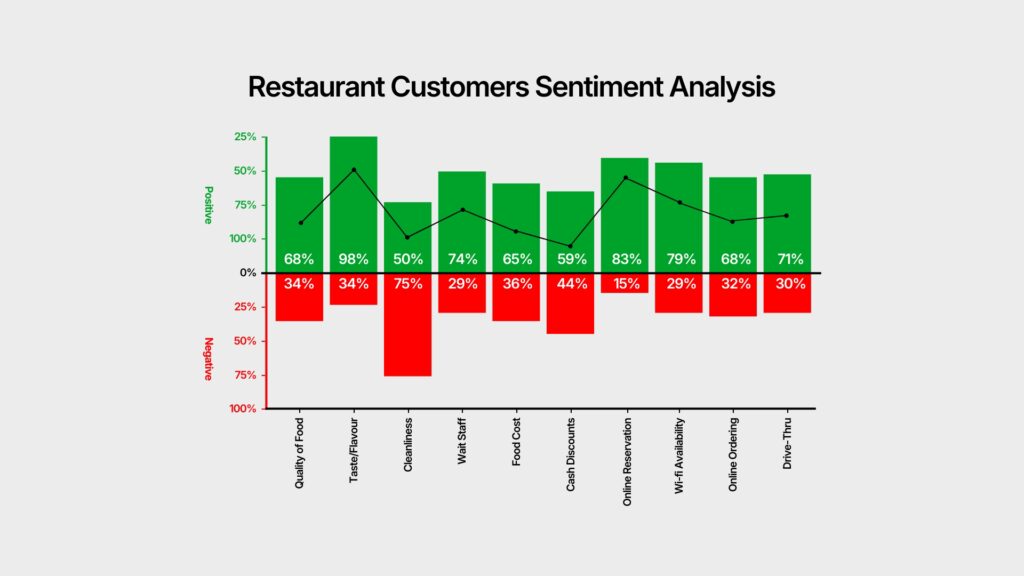
Benefits of Sentiment Analysis
Transforms Unstructured Data | Transforms unstructured text data into useful information. |
Improves Decision-Making | Makes it possible to make informed business decisions based on customer feedback. |
Enhances Customer Experience | Reveals feelings of customers to better connect with them. |
Real-Time Monitoring | Monitor public feelings on various platforms, including social media, reviews, and product feedback. |
Supports Business Strategy | Provides insight for better business planning. |
Scalable Emotion Analysis | Brings awareness to the emotions of consumers on a large scale for customer-centric business growth. |
Types of Sentiment Analysis
- Document-level Sentiment Analysis: It’s an overall analysis of the sentiment for an entire document (e.g., a review or report) including an evaluation of sentiment expressed by individual sentences.
- Sentence-level Sentiment Analysis: Judges the sentiment expressed in specific sentences.
- Aspect-based Sentiment Analysis: Identify sentiments regarding specific characteristics/features of the product (e.g., “Pricing,” “Customer Service,” or “Performance”).[4]
Challenges in Sentiment Analysis
- Language Complexity: Many people find it hard to tell when someone is being sarcastic or ironic when they use slang words.
- Context Dependency: Different contexts give the same word multiple meanings.
- Domain Sensitivity: Industry leaders have predicted that generic pattern models will not cover their needs.
- Multilingual Limitations: Accuracy is affected by cultural differences and language differences.
- Data Quality Issues: Unclean/bias data results in fewer trustworthy outcomes.
- Limited Emotional Depth: Standard custom patterns generated through traditional means result in limited analysis options (i.e., Only providing positive, negative and neutral assessments).
Bring structure and meaning to large datasets using StatsWork’s AI and ML expertise.
References
- Taboada, M. (2016). Sentiment analysis: An overview from linguistics. Annual Review of Linguistics, 2(1), 325-347.https://www.annualreviews.org/content/journals/10.1146/annurev-linguistics-011415-040518
- Qazi, A., Raj, R. G., Hardaker, G., & Standing, C. (2017). A systematic literature review on opinion types and sentiment analysis techniques: Tasks and challenges. Internet Research, 27(3), 608-630. https://www.emerald.com/intr/article-abstract/27/3/608/185844/A-systematic-literature-review-on-opinion-types?redirectedFrom=fulltext