
What is Predictive Analysis
- Home
- Insights
- Article
- What is Predictive Analysis
Qualitative Research Service
News & Trends
Recommended Reads
Data Collection
As the data collection methods have extreme influence over the validity of the research outcomes, it is considered as the crucial aspect of the studies
- 1. Introduction
- 2. DeepHealth’s Diagnostic Suite™: Revolutionizing Radiology Workflows
- 3. Key Features
- 4. AI Impact on National Screening Programs
- 5. SmartMammo™: Enhancing Breast Cancer Screening
- 6. DeepHealth AI Use Cases Across Specialties
- 7. Strategic Collaborations and Ecosystem Expansion
- 8. Impact and Adoption of DeepHealth’s AI Solutions
- 9. Conclusion: The Future of Radiology with AI
- 10. References
Introduction
Utilizing information from years gone by, mathematical algorithms, and AI techniques, predictive analysis (also referred to as predictive analytics) predicts the future. It aids in predicting future trends, behaviours, & risks through identification of data patterns that may not be visible with current data information through machine learning models.
Instead of using gut feelings or intuition as guidance, predictive analysis offers all decisions based on rational thought, statistics, and probabilities.
How Predictive Analysis Works
Step 1: Data Collection
Database, sensor and user interaction data is the source of data on historical and current events relevant to an organization.
Step 2: Data Cleaning
Errors, duplicates and inconsistencies are removed from the data to make it reliable.
Step 3: Data Analysis
Patter/trends/relationships contained in the data are studied and understood.
Step 4: Model Development
Regression analysis, decision trees, machine learning are just a few of the many patterns/relationships found within the data, that can be used to establish predictive models of future occurrence.
Step 5: Prediction & Planning
Forecasts provided by validated models enable organizations to prepare for the future and develop a plan to respond proactively.[2]
Techniques Used in Predictive Analysis
- Statistical Modelling: Uses relationships between independent and dependent variables to enable forecasting of variability in predictions.
- Data Mining: Uses Historical Analysis to identify previously unknown trends and patterns contained in large collections of data.
- Machine Learning: Uses Historical Methodologies to identify trends in the analysis of data provided.
- Time-Series Analysis: Utilizes historical analysis of current data to develop future forecasting models.
- Artificial Intelligence: Utilizes Complex Data Analysis to improve the accuracy of forecasting models.
Applications of Predictive Analysis
Industry | Application of Predictive Analysis |
Business | Sales, demand and potential customer churn forecasts assist in improved planning. |
Manufacturing | Predictive maintenance is achieved by predicting possible equipment failure. |
Healthcare | Predictive analysis can be used to estimate a patient’s disease risk and to help healthcare forecasting patient outcomes. |
Finance | Fraud detection and credit risk assessment enable safer decisions to be made. |
Marketing | Predictive modelling can be used to forecast a future customer behaviour and enhance the performance of campaigns.[4] |
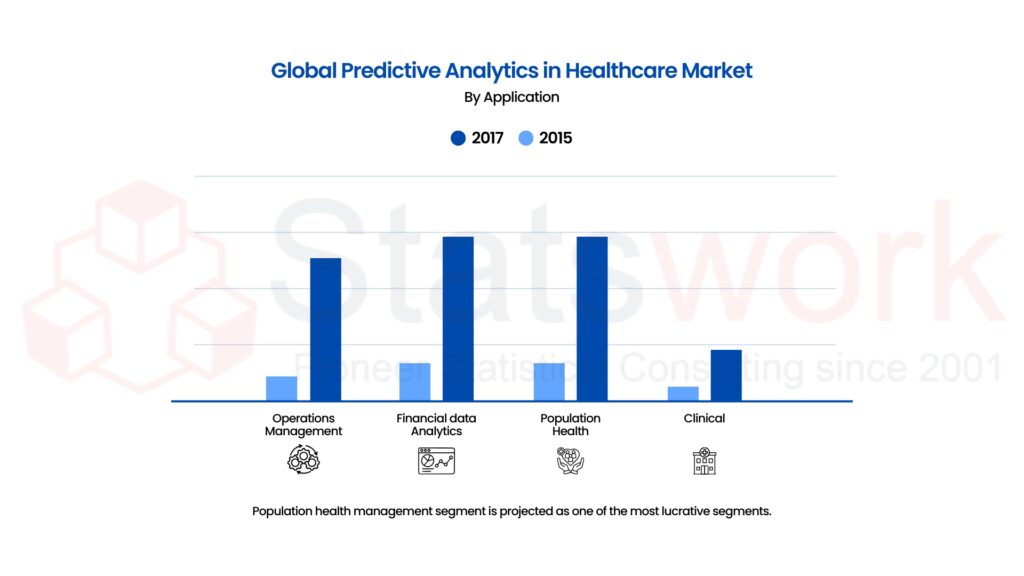
Fig 1 Shows healthcare predictive analytics growth from 2015 to 2017, with population health rising fastest.
Benefits and Challenges
Benefits | Challenges |
Improves Decision Making | Data Quality Issue |
Reduced Business Risks | Model Complexity |
Saves Cost | Data Privacy Concerns |
Enhances Operational Efficiency | Need for Skilled Professionals |
Enables proactive planning | Integration with existing systems. |
Through predictive analysis, organizations gain the ability to forecast their future, reduce unpredictability, and remain competitive by analysing raw data and providing a way to generate actionable insights from the data they possess.
Build smarter systems, predict better outcomes, and scale with confidence - accelerate your success with StatsWork AI & ML.
References
- Rummens, A., Hardyns, W., & Pauwels, L. (2017). The use of predictive analysis in spatiotemporal crime forecasting: Building and testing a model in an urban context. Applied geography, 86, 255-261. https://www.sciencedirect.com/science/article/abs/pii/S0143622816304957
- Yun, C., Shun, M., Junta, U., & Browndi, I. (2022). Predictive analytics: A survey, trends, applications, opportunities’ and challenges for smart city planning. International journal of computer science and information technology, 23(56), 226-231. https://isi.ac/storage/article-files/N8nkU3J0BnFlVpfps2FLxYaFRoBiKlwHFWWRD2p6.pdf