Data Analysis services

Meta-Analysis Research Services

Data Collection Services

Statistical Programming & Biostatistics services

Data Management Services

Research methodology services

Tool development services
Statistical Interpretation services

Statistical Interpretation services
Sample Size Calculation Services

Sample Size Calculation Services
Artificial Intelligence and Machine Learning Services

Artificial Intelligence and Machine Learning Services
Report generation Service

Report generation Services

Data Analysis services

Meta-Analysis Research Services

Data Collection Services

Statistical Programming & Biostatistics services

Data Management Services

Research methodology services

Tool development services
Statistical Interpretation services

Statistical Interpretation services
Sample Size Calculation Services

Sample Size Calculation Services
Artificial Intelligence and Machine Learning Services

Artificial Intelligence and Machine Learning Services
Report generation Service

Report generation Services
The presence of overlapping voices and different accents are two major problems associated with the process of audio transcription and lead to poor accuracy rates and increased errors in business operations, education and science. The above-mentioned obstacles can be overcome by combining automated transcription tools, speaker diarization, accent specialists, knowledge of a few languages and quality control standards.
Global companies thrive on dialogue — conversations between salespeople, boardroom discussions, research interviews, and international negotiations produce audio material that will later need to be transcribed. But two constant barriers are standing in the way of even the most sophisticated audio transcription processes: overlapping speech and different accents. Ignoring these problems can slowly lower the accuracy of the transcription process and cause delays and costly mistakes in research and compliance documentation [1].
This guide explores why these barriers exist, what they cost you, and how contemporary speech accent transcription services overcoming them.
In any recording with multiple speakers, be it a corporate town hall meeting, focus group, or panel interview, individuals will inevitably overlap in their speech. Transcribers, both automated or human, find it difficult to identify individual speakers when:
It is one of the most frequently occurring problems for transcription with the presence of accents complicating the issue even further because overlapping speech becomes even more difficult to associate with individual speakers [2].
Since firms have expanded into more than one region, it becomes essential to have transcription systems that are multilingual for firms. The meetings may include people from North America, South Asia, Europe, and other regions, who have different accents, speech rhythm, and regional vocabulary. Transcription systems that are good for one accent fail with:
It is essential to have accent neutral transcription systems to avoid any errors in transcription [3].
| Challenge | Effect on Business | Solution Strategy |
| Overlapping Speech | Leads to incomplete quotations and inaccurate transcripts. | Use speaker diarization combined with manual transcript review. |
| Strong or Regional Accents | Causes misinterpreted words and loss of contextual meaning. | Employ accent-trained transcriptionists and speech recognition models. |
| Poor Audio Quality | Increases transcription errors and rework. | Apply audio preprocessing and enhancement software before transcription. |
| Multilingual Meetings | Creates terminology inconsistencies and translation challenges. | Use bilingual transcriptionists with relevant domain expertise. |
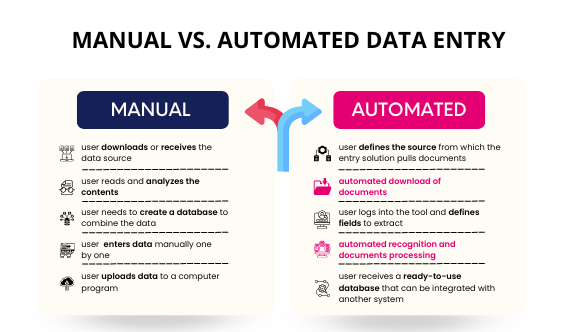
| Manual Coding Only | Consumes significant time and increases operational costs. | Implement enterprise transcription software with human quality review. |
An erroneous transcript can not only waste valuable time but also skew the results of any qualitative research, mislead the customers, and result in compliance issues in sectors such as healthcare, law, and finance. That is why audio transcription services are now expected to guarantee accuracy, along with timely service delivery.
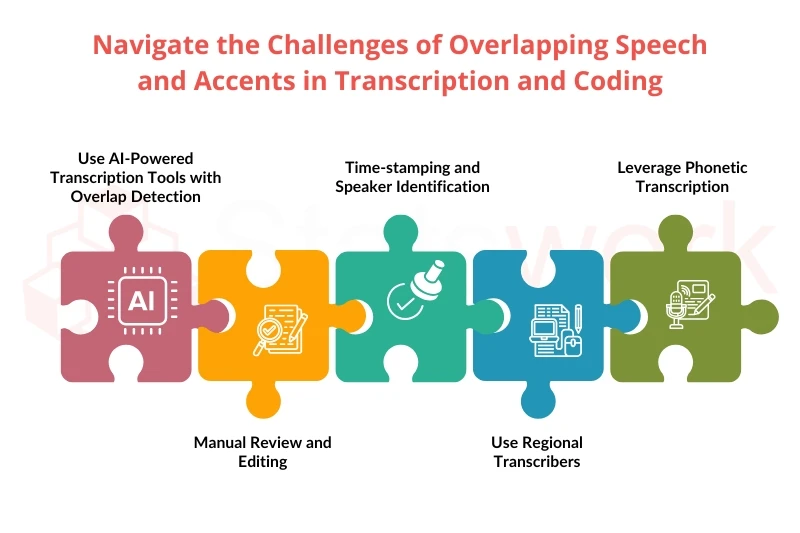
Those organizations which produce high-quality clean transcriptions regularly rely on three factors which include human skills, specialized technology and the process of quality control. Let’s see how it is done.
1. Add Technology to Human Management
The software used in enterprise transcription currently employs AI for speaker dualization by separating different voices through vocal signature isolation. However, even with advanced technology, sometimes there will be problems with accents and crosstalk. The most efficient workflow involves human verification of the result provided by the machine.
2. Assign Transcribers Based on Accent Knowledge
Companies which can perform real accent recognition assign transcriptionists having experience with regional languages such as South Asian, African, East Asian or European variety of English rather than one generic model. This simple step usually solves many problems connected with accent problems [2].
3. Create Corporate Meeting Transcription Guidelines
For regular transcription within organizations, corporate meeting transcription requires the following rules:
4. Build in a Verification Layer for Research Coding
Where transcripts feed into qualitative coding or thematic analysis, a second-pass verification round — checking transcript against audio for critical passages — substantially improves transcription accuracy before analysts begin coding.
5. Choose Providers With Multilingual and Domain Expertise
Business transcription projects spanning multiple markets need vendors who combine linguistic range with subject-matter familiarity, whether that’s academic research, market research, legal proceedings, or clinical interviews. This combination reduces the guesswork that generic transcription services often introduce.
Academic research increasingly backs up what transcription providers see in practice. A 2025 engineering review of accent conversion technology describes accents as a natural reflection of cultural, regional, and linguistic diversity that can nonetheless make communication difficult in global settings, and notes that deep learning has meaningfully improved the naturalness and flexibility of systems designed to bridge accent differences — though challenges around prosody and real-time processing remain.
A separate 2026 study on voice-driven software tools takes this a step further into the coding and technical domain [2]. The researchers point out that most speech-to-text systems are built for English-speaking keyboard users, which limits accessibility for multilingual, voice-first environments, and found that spoken technical queries containing custom identifiers, domain-specific terms, and code-mixed language create distinctive transcription failure patterns that standard ASR models handle poorly.
Notably, the study also showed that refining raw transcription output with large language models substantially improved accuracy on both the transcription and downstream understanding stages a strong argument for the layered “software plus human/LLM review” model recommended throughout this guide, especially for technical or research transcripts destined for coding and analysis.
Selecting the right corporate transcription services requires the following characteristics from service providers:
Overlapping speech and accent diversity will always be part of real-world business and research conversations — but they don’t have to compromise the integrity of your transcripts. By combining accent-aware transcriptionists, dualization-enabled software, and a disciplined quality-review process, organizations can turn even the most complex multi-speaker, multi-accent recordings into clean, reliable, codable text. The right blend of professional transcription expertise and technology is what ultimately separates accurate, decision-ready transcripts from costly guesswork.
Don’t let overlapping speech, accents, or poor audio quality affect your business decisions. Statswork provides enterprise-grade transcription services with multilingual expertise, speaker diarization, and rigorous quality assurance to deliver transcripts with exceptional accuracy. Request a free consultation and experience transcription you can rely on.
Common challenges include background noise, overlapping speakers, strong accents, poor audio quality, fast speech, and technical terminology, all of which can affect transcription accuracy.
Accuracy is improved by using advanced noise reduction tools, AI-assisted transcription, repeated audio reviews, speaker identification, and manual proofreading by experienced transcriptionists.
The biggest challenge is accurately recognizing spoken words in recordings with background noise, overlapping conversations, accents, or unclear pronunciation while maintaining context.
Overlapping speech occurs when two or more speakers talk at the same time, making it difficult to distinguish individual voices during transcription.
An example is during a business meeting when two participants interrupt each other and speak simultaneously, causing their voices to overlap in the recording.
Overlapping audio can be reduced using AI-powered audio enhancement, speaker separation technology, noise reduction software, and manual editing to isolate individual voices before transcription.
WhatsApp us