statswork

Stronger Analysis. Smarter Research. Bigger Savings!
Access expert statistical analysis and research support at Flat 24% Off
Stronger Analysis. Smarter Research. Bigger Savings!
Access expert statistical analysis and research support at Flat 24% Off.

Why Do Some Statistical Modifications Clear Route B in 14 Days While Others Stall Your UK Trial?

Summary

UK Route B can speed up some substantial modifications, but most statistical changes will not qualify. The statistical Route B categories depend on the identical change having already been approved in the EU, EEA or USA. Stopping-rule changes, significant changes in participant numbers and major endpoint changes are Route A.

Since the amended UK regulations took full effect on 28 April 2026, substantial modifications follow Route A (full review) or Route B, where the licensing authority confirms automatic approval within 14 calendar days of validation. [2] Which route a revised sample size, endpoint, interim analysis or SAP takes depends more on regulatory classification than on statistical quality.

Step 1: Is the Change Substantial at All?

A modification is substantial when it is likely to have a substantial impact on participants’ safety or rights, or on the reliability or robustness of the trial data. [2] Many statistical analysis plan (SAP) edits fall below that threshold: correcting a derivation or adding a supportive sensitivity analysis usually leaves the approved estimand, endpoint and decision rule unchanged. Classify against the approved protocol, not the SAP version.

Step 2: Check the Route A List First

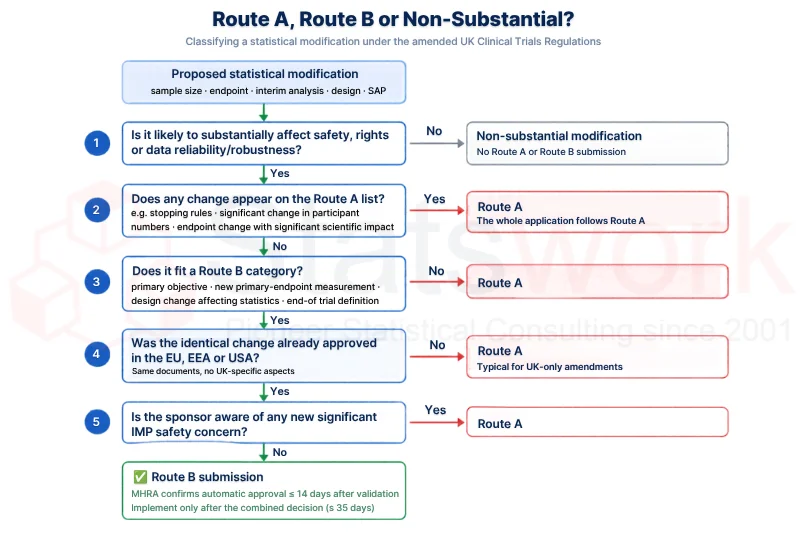
MHRA guidance lists modifications that are Route A. Three are directly statistical: [2]

  • a significant change in the absolute number of trial participants;
  • a change to stopping rules for any part of the trial;
  • changes to primary or secondary endpoints with a significant impact on the safety or scientific value of the trial. One Route A modification in a bundled application sends the whole application through Route A. [2]

Step 3: Does It Fit a Route B Category and Condition?

MHRA’s Route B table includes four categories with direct statistical content: a change to the primary objective, new measurements for the primary endpoint, design changes with a significant impact on statistical considerations, and changes to the definition of the end of the trial. [3]

These categories qualify only where the identical change has already been approved as a substantial amendment or modification in the EU, EEA or USA, using the same documents with no UK-specific aspects. [3] The sponsor must also, after reasonable enquiries, know of no new significant safety concerns with the investigational medicinal product. [1,2]

In practice, a UK-only statistical amendment will usually go through Route A, however well justified.
MHRA clinical trials

Figure 1. Classifying a statistical modification under the amended UK regulations

Worked Example 1: A Sample-Size Increase

A two-arm trial was approved with 400 participants (200 per arm), 90% power and a two-sided 5% significance level, which implies a standardised effect size of about 0.32. Blinded pooled data show the outcome variance is 15% higher than assumed. Because the required sample size scales with variance, keeping 90% power needs about 460 participants. Staying at 400 would cut power to about 86%.

MHRA does not define “significant” numerically, so the sponsor must judge whether 60 extra participants (+15%) is a significant change in absolute numbers. If it is, the change is Route A, however sound the recalculation. Document the original and revised assumptions and confirm that the blinded review used no comparative data.

Worked Example 2: Adding an Efficacy Interim

Testing the same hypothesis at 60% and 100% information, each at an unadjusted two-sided 0.05 level, raises the overall Type I error to about 8%. A Lan–DeMets O’Brien–Fleming-type spending function prevents this. It spends about 0.011 at the interim (boundary z ≈ 2.53) and leaves a final boundary of z ≈ 2.00 (nominal p ≈ 0.046). [5,6]  Secondary endpoint multiplicity control must then be rechecked.

The design is defensible, but an efficacy interim introduces a stopping rule, and stopping-rule changes are Route A. [2] Sound alpha control does not change the route.

Worked Example 3: Binary Response to Time-to-Event

Moving from response at week 24 to time to response changes the estimand, not just the model. The summary measure shifts from a risk difference or odds ratio to a hazard ratio, censoring needs a strategy, and a Cox model assumes proportional hazards; where that is doubtful, restricted mean survival time is more interpretable. ICH E9(R1) expects the estimand, estimator, assumptions and sensitivity analyses to align. [4] A change of this size usually has a significant impact on scientific value, placing it in Route A.

What the Statistical Package Should Contain

Whichever route applies, an assessor should be able to trace the change: objective → estimand → endpoint → population → estimator → assumptions → multiplicity → sensitivity analyses → decision rule.

Element

What to document

Estimand

Original versus revised estimand and intercurrent-event strategies

Sample size

Original and revised assumptions, power and precision

Operating characteristics

Type I error, power, boundaries and expected sample size

Multiplicity

Updated testing hierarchy or alpha allocation

Consistency

Protocol, SAP and calculations agree

Table 1. Minimum statistical content for a modification package

What “14 Days” Actually Means

For a valid Route B application, the licensing authority confirms automatic approval within 14 calendar days of validation. However, the ethics committee reviews Route B modifications as it does Route A, and the change cannot be implemented until the combined decision, issued within 35 calendar days of validation. [2] If the Route B criteria are not met, the application proceeds as Route A unless the sponsor withdraws it. [2] Plan implementation around 35 days, not 14.

Get the Route Right Before You File

Statswork’s Statistical and Biostatistical Services provide sample-size re-estimation, group-sequential design, operating-characteristic simulations and protocol–SAP consistency review, delivering a documented justification your regulatory team can use to classify and submit the change.

Talk to a Statswork biostatistician before you submit your modification.

Conclusion

Route B is narrower than its 14-day headline suggests. Most statistical modifications are non-substantial or Route A, and the statistical Route B categories depend on prior EU, EEA or US approval. Classify first, then show that the revised trial still answers its question with controlled error rates.

Frequently Asked Questions (FAQs)

Route B is a pathway for specified substantial modifications in which the MHRA confirms automatic approval within 14 days of validation. Implementation still waits for the combined decision.

Usually not. The statistical categories require prior approval of the identical change in the EU, EEA or USA.

Not if it introduces or changes stopping rules; that is Route A. In either case, the design must control the overall Type I error.

Only if they are likely to substantially affect data reliability or robustness, for example by changing the primary analysis.

References:

  1. UK Government. The Medicines for Human Use (Clinical Trials) (Amendment) Regulations 2025 (SI 2025/538), amending the Medicines for Human Use (Clinical Trials) Regulations 2004. https://www.legislation.gov.uk/uksi/2025/538
  2. Medicines and Healthcare products Regulatory Agency (MHRA). Clinical trials for medicines: modifying a clinical trial approval. Updated 19 August 2026. https://www.gov.uk/guidance/clinical-trials-for-medicines-modifying-a-clinical-trial-approval
  3. Route B substantial modifications (Table 1). Accessed 7 October 2026. https://assets.publishing.service.gov.uk/media/68dbc859ef1c2f72bc1e4c33/Tab1._Route_B_substantial_modifications.pdf
  4. International Council for Harmonisation (ICH). E9(R1): Addendum on Estimands and Sensitivity Analysis in Clinical Trials. 2019. https://database.ich.org/sites/default/files/E9-R1_Step4_Guideline_2019_1203.pdf
  5. DeMets DL, Lan KKG. Interim analysis: the alpha spending function approach. Statistics in Medicine. 1994;13(13–14):1341–1352. https://doi.org/10.1002/sim.4780131308
  6. Pocock SJ. Group sequential methods in the design and analysis of clinical trials. Biometrika. 1977;64(2):191–199. https://doi.org/10.1093/biomet/64.2.191

Contact us