statswork

Stronger Analysis. Smarter Research. Bigger Savings!
Access expert statistical analysis and research support at Flat 24% Off
Stronger Analysis. Smarter Research. Bigger Savings!
Access expert statistical analysis and research support at Flat 24% Off.

Can an International Meta-Analysis Prove “Appropriateness” for Swiss Patients? How FOPH Assesses Transferability

Summary

An international meta-analysis can supply the strongest available evidence of a treatment effect, but a pooled estimate does not by itself establish appropriateness for Swiss patients. FOPH’s own operationalisation of the EAE criteria asks whether study results can be applied to Swiss clinical practice, and appropriateness also covers care-pathway, quality, legal, ethical and societal questions that no statistic answers. The statistical task is to show, transparently, whether and how the international effect carries over to the defined Swiss target population.

An international meta-analysis can show that a treatment works across the populations studied. It cannot, by itself, show that the same effect applies to Swiss patients, and it cannot settle appropriateness, which under Swiss law is broader than any treatment-effect estimate. What a well-designed meta-analysis can do is make the route from international evidence to a Swiss-specific conclusion explicit, quantified and open to scrutiny. That is the difference between evidence FOPH questions and evidence FOPH can assess.

This article explains what FOPH asks about transferability, which statistics answer those questions (and which do not), and how to estimate a treatment effect for the Swiss target population, with two worked examples and a pre-submission checklist.

What FOPH Means by Appropriateness and Where Transferability Fits

Services reimbursed by Swiss compulsory health insurance must be effective, appropriate and economically efficient — the EAE criteria (in German, Wirksamkeit, Zweckmässigkeit, Wirtschaftlichkeit, or WZW) set out in Article 32 of the Federal Health Insurance Act (KVG). FOPH’s operationalisation document, valid since 1 September 2022, defines how each criterion is assessed [1].

Under that document, a service is appropriate if it is relevant to and suitable for patient care compared with alternative procedures, is consistent with legal requirements and ethical and societal values, and its quality and appropriate use are ensured in practice [1]. Its sub-criteria include the service’s place in the care pathway, quality-assurance requirements, avoidance of misuse, and legal, ethical and societal aspects.

Two points follow, and both matter for anyone submitting international evidence:

  • Transferability is not only an appropriateness question. FOPH’s definition of effectiveness already requires that study results can be assumed to apply to the Swiss clinical practice setting, and the guidance asks how Swiss patient populations and everyday practice conditions differ from those in the clinical studies [1]. A transferability gap therefore weakens the effectiveness case first.
  • Appropriateness cannot be proven statistically. A meta-analysis can inform comparative benefit and harm, but questions about the care pathway, quality assurance, legal fit and societal values need clinical, organisational and ethical evidence as well.

EAE criterion

What FOPH examines

What a meta-analysis can contribute

What it cannot settle

Effectiveness

Benefit and harm on critical outcomes; certainty of evidence; applicability to Swiss clinical practice

Pooled relative effects, heterogeneity, prediction intervals, effect-modifier analyses, certainty ratings

Applicability when effect modifiers differ between the studies and Switzerland and were not analysed

Appropriateness

Relevance and suitability versus alternatives; place in care pathway; quality assurance; legal, ethical and societal aspects

Comparative effects against comparators used in Swiss practice; subgroup evidence that informs appropriate use

Legal, ethical, societal and quality-assurance judgements

Economic efficiency

Cost relative to benefit and to alternatives

Absolute effects at Swiss baseline risk, used as inputs to economic models

Swiss costs, prices and budget impact

Why a Precise Pooled Estimate Can Still Miss Swiss Patients

A meta-analysis combines study-specific estimates into an overall effect. In a random-effects model, that overall effect is the mean of a distribution of true effects across the settings that were studied — not the effect in any particular country. A narrow confidence interval tells you that this mean is estimated precisely. It says nothing about whether Swiss patients resemble the patients behind it.

Transferability is therefore a question of external validity, not of statistical significance. A very precise international estimate can still have limited relevance if the factors that change the treatment effect are distributed differently in Switzerland.

Evidence feature

What it establishes

What it does not establish

Pooled treatment effect

Average effect across the contributing studies

The effect in a population with a different case mix

Narrow confidence interval

Precision of that average

Relevance to Swiss patients

Similar baseline characteristics

Comparability on the variables measured

Absence of unmeasured effect modifiers

Low statistical heterogeneity

Consistency among the included studies

Similarity between those studies and Switzerland

Significant treatment-by-covariate interaction

Evidence that the effect varies with that covariate

A valid Swiss-specific estimate without further modelling

Prognostic Factors vs Effect Modifiers: The Distinction Reviewers Test

Population differences matter statistically only when they change the treatment effect. A prognostic factor predicts the outcome regardless of treatment: older patients may have higher mortality whichever arm they are in. An effect modifier changes the size or direction of the treatment effect itself: the drug works better, or worse, in older patients.

One subtlety is frequently missed: effect modification depends on the scale. If a treatment reduces risk by the same relative amount in every age group, age is not an effect modifier on the relative scale. But because older patients have a higher baseline risk, the absolute benefit is larger for them, so age is an effect modifier on the absolute scale. A Swiss population with a different age structure can therefore have the same relative effect and a different absolute benefit. Analysts should state which scale they are assessing transferability on.

How to examine effect modification credibly

  • Test the interaction, not separate subgroups. Comparing a significant p-value in one subgroup with a non-significant one in another is not evidence of a difference. The test of interaction is.
  • Use within-trial information. In individual participant data (IPD) meta-analysis, Riley et al. recommend estimating treatment–covariate interactions from within-trial information to avoid aggregation (ecological) bias and modelling continuous covariates without arbitrary categorisation [2].
  • Remember power. Interaction tests usually have far less power than the main-effect test. A non-significant interaction is not evidence that no effect modification exists.
  • Prespecify candidates. Effect modifiers should be chosen on clinical and biological grounds before the analysis, not discovered by trawling many subgroups.

What Q, I², τ² and Prediction Intervals Can and Cannot Tell You

Heterogeneity describes how much the estimated treatment effects vary across studies. It is essential to report, but no heterogeneity statistic measures whether international evidence applies to Switzerland. Borenstein sets out the distinct role of each measure [3]:

Statistic

Question it answers

Common misreading

Use for Swiss transferability

Cochran’s Q

Is there more variation than sampling error alone would produce?

A non-significant Q means the effects are homogeneous (Q has low power when there are few studies)

Indirect at best

I²

What proportion of the observed variance reflects variation in true effects?

I² = 25% means heterogeneity is small in absolute terms (I² is a proportion, not an amount)

None on its own

τ² (and τ)

How much do true effects vary, in the units of the effect size?

Rarely reported or interpreted

Quantifies spread across the settings studied

95% prediction interval

Where is the true effect in a new, comparable setting likely to fall?

Treated as the same as the confidence interval

Most informative, but only if Switzerland resembles the settings studied


Worked example: a significant pooled effect with a prediction interval that crosses 1

Suppose 12 trials give a random-effects pooled hazard ratio (HR) of 0.80 (95% CI 0.72 to 0.89) with τ = 0.15 on the log-HR scale. The standard error of the pooled log-HR is about 0.054. The 95% prediction interval uses t with k − 2 = 10 degrees of freedom (2.228):

exp [ln (0.80) ± 2.228 × √ (0.15² + 0.054²)] = 0.56 to 1.14

The confidence interval excludes 1, so the average effect is clearly beneficial. The prediction interval includes 1, so in some comparable settings the true effect may be null or slightly harmful. That is exactly the uncertainty a Swiss reviewer will ask about — and it applies only if Switzerland is comparable to the trial settings in the first place. (Illustrative numbers.)

Low heterogeneity does not establish Swiss applicability

Low heterogeneity can increase confidence that the included studies estimate a similar effect. It does not show that the same effect would occur in Swiss practice. If two trials report almost identical hazard ratios but both enrolled patients a decade younger than the Swiss target population, their agreement does not remove the age difference. Agreement among similar studies is consistency, not transferability.

In GRADE terms, which FOPH uses to rate certainty of evidence [1], this is indirectness: differences between the study populations, interventions, comparators or outcomes and those of the decision question can lower the certainty rating even when the trials themselves are well conducted [4].

Transferability and Transportability: Related but Not the Same

Transferability is the broad HTA question of whether evidence generated in one setting can reasonably inform a decision in another. It covers differences in patients, clinical practice, comparators, resource use and health-system organisation. Turner et al. discuss these considerations for moving comparative-effectiveness evidence between countries in HTA, emphasising a clearly defined target population and estimand and the identification of effect modifiers [5].

Transportability is a formal causal-inference framework. It reweights or models trial data so that the estimate targets a specified population rather than the trial sample [6]. Its validity rests on three assumptions that should be stated explicitly in any submission:

  • Exchangeability of effects across populations: conditional on the measured covariates, the treatment effect is the same in the trials and in the Swiss target population. In practice, every effect modifier whose distribution differs must be measured in both data sources.
  • Positivity (overlap): every covariate pattern present in the Swiss target population has some chance of appearing in the trials.
  • Consistency: the treatment, comparator and outcome as delivered in the trials correspond to those in Swiss practice.

These methods are still used relatively rarely across borders. A 2026 review identified 13 practical applications of transportability; ten used inverse odds of sampling weights, and most transported trial results to real-world populations within a single country, with few cross-country applications [7]. Formal transportability is therefore a useful tool, not an established FOPH requirement, and it should not be presented as a method FOPH has adopted.

Lessons from FOPH’s Knee Arthroscopy HTA

FOPH’s HTA of knee arthroscopy for degenerative changes offers a concrete Swiss illustration. International cost-effectiveness studies were assessed for qualitative transferability to Switzerland; for studies judged transferable, cost estimates were adapted to Switzerland and the cost-effectiveness results recalculated [8].

The lesson is not that this single report defines a universal FOPH statistical method. It is that FOPH does not treat international evidence as context-free: population, practice patterns, comparators and costs are examined, and where possible the evidence is adapted to Swiss conditions rather than accepted at face value. For more on how pooled estimates support decisions, see our guide to meta-analysis for evidence-based decisions.

A Statistical Framework for Assessing Swiss Applicability

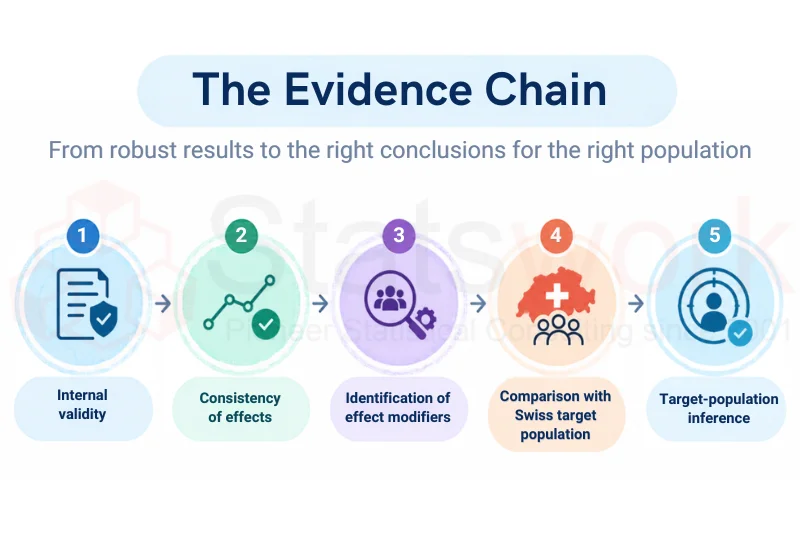
A defensible assessment establishes three connected points, in this order:

  1. The evidence is internally credible. Study design, risk of bias, outcome definitions, estimands and analysis methods support valid treatment-effect estimation.
  2. The effects are consistent, or their variation is understood. Q, I², τ² and the prediction interval are reported and interpreted together, and plausible effect modifiers have been examined [2, 3].
  3. The evidence supports an inference for the defined Swiss target population. Effect modifiers are identified, their distributions in the trials and in Switzerland are compared, overlap is checked, and an appropriate target-population method is applied with its assumptions stated.
effect modifiers

Figure 1. The evidence chain from internally valid trials to an inference for the Swiss target population. Each step must hold for the next to be credible.

Estimating a Treatment Effect for the Swiss Target Population

The first step is to define the causal estimand for the population the decision concerns. For the Swiss target population, the average treatment effect is:

ATE(Swiss) = E [Y1 − Y0 | S = 0]

where Y1 and Y0 are the potential outcomes under treatment and comparator, and S = 0 denotes membership of the Swiss target population rather than the trial samples. Dahabreh et al. describe estimators that transport inferences from multiple randomised trials to such a target population, using trial data together with covariate data from the target population [6].

Estimating this quantity requires Swiss data on the effect modifiers, ideally at individual level for example from Swiss registries, cohort studies or routine hospital statistics, provided they record the relevant covariates. Which method is appropriate depends on what data are available:

Method

When it is appropriate

Data required

Key limitation

Conventional meta-analysis

Describing the average effect in the studied populations

Study-level effect estimates

Describes the evidence base, not Switzerland

Subgroup analysis

A few prespecified, clinically plausible modifiers

Subgroup estimates from each study

Low power; risk of spurious findings

Meta-regression

Exploring study-level sources of heterogeneity

Enough studies, with study-level covariates

Ecological bias; unreliable with few studies

IPD meta-analysis

Estimating participant-level treatment–covariate interactions

Individual participant data from the trials

Access, time and cost

Standardisation or reweighting

Re-expressing subgroup effects for the Swiss case mix

Subgroup effects plus Swiss covariate distribution

Needs the relevant modifiers and adequate overlap

Formal transportability

Estimating a Swiss target-population causal effect

Trial IPD plus Swiss target-population covariates

Depends on exchangeability, positivity and consistency


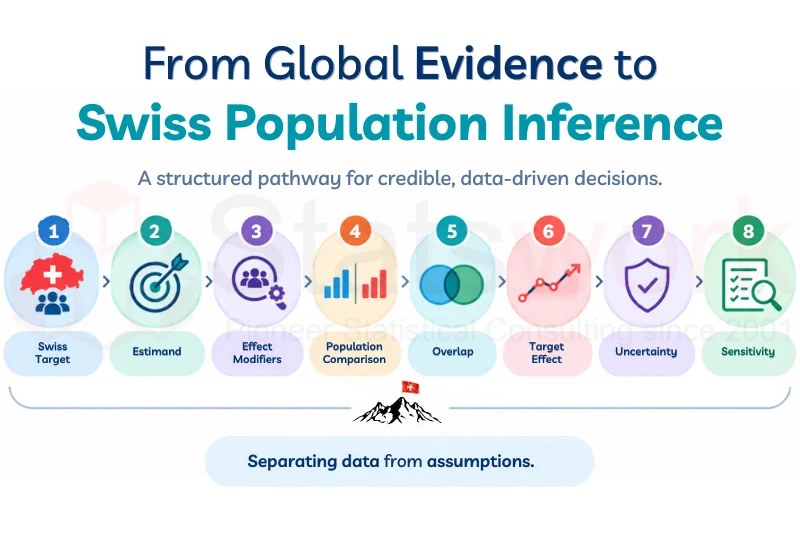
Overlap is the limit of every method. If 25% of the Swiss target population is over 80 but no trial enrolled anyone over 80, reweighting cannot create evidence for that group. The honest options are to restrict the estimand to the age range covered, report the gap explicitly, or extrapolate under a stated assumption and test it in sensitivity analyses. (Illustrative figures.)
EAE criteria appropriateness

Figure 2. An eight-step workflow from defining the Swiss target population to sensitivity analysis. It separates what the data show from what is assumed.

Worked Example 1: Population Composition Changes the Average Benefit

Assume the international evidence base contains 70% moderate-risk patients, with an absolute treatment benefit of 5 percentage points, and 30% severe-risk patients, with a benefit of 15 percentage points.

Population

Moderate-risk share

Severe-risk share

Population-average absolute benefit

International evidence base

70% (benefit 5 pp)

30% (benefit 15 pp)

(0.70 × 5) + (0.30 × 15) = 8.0 pp

Swiss target population

40% (benefit 5 pp)

60% (benefit 15 pp)

(0.40 × 5) + (0.60 × 15) = 11.0 pp


The subgroup effects have not changed; only the case mix has. Yet the average benefit for the Swiss target population is 11 rather than 8 percentage points. A real analysis would also carry the uncertainty of each subgroup estimate into the standardised result and check that the subgroup effects are themselves credible. (Illustrative figures; pp = percentage points.)

Worked Example 2: The Same Relative Effect, a Different Absolute Benefit

Suppose the pooled risk ratio is 0.80 and is judged transferable. In the trials, the control-group event risk was 10%. Swiss data suggest a baseline risk of 6% in the target population.

Setting

Baseline risk

Risk with treatment (RR 0.80)

Absolute risk reduction

Number needed to treat

Trials (international)

10.0%

8.0%

2.0 pp

50

Swiss target population

6.0%

4.8%

1.2 pp

84

The relative effect is identical, but each Swiss patient gains less in absolute terms, and about 84 rather than 50 patients must be treated to prevent one event. Because economic evaluations use absolute effects, this difference flows directly into the economic-efficiency assessment. Baseline risk should therefore come from Swiss data wherever possible. (Illustrative figures.)

What FOPH Reviewers Are Likely to Challenge — and the Evidence That Answers It

Likely challenge

Evidence that answers it

Are the trial populations comparable to Swiss patients?

Side-by-side table of key covariates in the trials and a Swiss data source, with standardised differences

Is the comparator used in Swiss practice?

Comparator mapping to Swiss practice; indirect comparison or network meta-analysis where the trial comparator differs

Does the effect vary with plausible modifiers?

Prespecified interaction analyses, using IPD where available

How much do true effects vary across settings?

τ and the 95% prediction interval, not I² alone

What is the absolute benefit for Swiss patients?

Absolute effects and NNT calculated at Swiss baseline risk

Are some Swiss patient groups unrepresented?

Overlap diagnostics and an explicit statement of evidence gaps

How certain is the conclusion?

GRADE certainty ratings, including indirectness, plus sensitivity analyses of key assumptions


Common mistakes that weaken a submission

  • Treating a narrow confidence interval as proof of relevance to Switzerland.
  • Reading a low I² as proof that the effect is the same everywhere.
  • Comparing p-values across subgroups instead of testing the interaction.
  • Reporting only relative effects when Swiss baseline risk differs.
  • Reweighting to a Swiss population that the trials do not cover.
  • Presenting a transportability estimate as if it were an FOPH-endorsed method.

How Statswork Helps You Build a Defensible Swiss Evidence Case

The problem: your international evidence is strong, but you need to show — before FOPH asks — whether it applies to Swiss patients, and what happens to the estimate if it only partly does.

What Statswork does: our biostatisticians design or re-analyse your meta-analysis, examine heterogeneity and treatment-effect modification, define the Swiss target-population estimand, and apply aggregate-data, IPD or transportability methods suited to the data you hold.

What you receive: a transferability report covering a population-comparison table, effect-modifier and interaction analyses, prediction intervals, Swiss-standardised relative and absolute effects with uncertainty, sensitivity analyses and reproducible analysis code.

Next step: share your evidence base and target-population definition with the Statswork team for a scoped review of what your current data can support.

Conclusion

An international meta-analysis can strengthen a Swiss reimbursement case, but its pooled estimate does not by itself prove appropriateness. FOPH asks whether study results apply to Swiss clinical practice, and appropriateness also covers questions that statistics cannot answer. The statistical work is to identify effect modifiers, interpret heterogeneity through τ and prediction intervals, check overlap, and estimate relative and absolute effects for the defined Swiss population with every assumption stated. This gives FOPH evidence it can assess rather than evidence it must question.

Frequently Asked Questions (FAQs)

Yes. International evidence is routinely used, but FOPH assesses whether the study results apply to Swiss clinical practice. The submission should show how the study populations, comparators and practice conditions compare with Switzerland rather than assume they are the same.

No. Statistical significance shows that the average effect in the studied populations is unlikely to be zero. Appropriateness also covers the care pathway, quality assurance, and legal, ethical and societal aspects, which require evidence beyond a treatment-effect estimate.

No. A low I² means the included studies give consistent results. If those studies share similar populations that differ from Swiss patients, consistency does not establish transferability.

Transferability is the broad HTA judgement about whether evidence from one setting can inform another. Transportability is a formal causal-inference method that estimates a treatment effect for a specified target population, under stated assumptions such as positivity and exchangeability.

Absolute benefit depends on baseline risk. With a risk ratio of 0.80, a baseline risk of 10% gives a 2-point reduction, but a baseline risk of 6% gives only 1.2 points. Swiss baseline risk should therefore be used to calculate absolute effects.

At minimum, trial results by effect modifier and the distribution of those modifiers in the Swiss target population. Formal transportability methods need individual-level trial data and Swiss covariate data, plus adequate overlap between the two populations.

References:

  1. Federal Office of Public Health (FOPH). Operationalisation of the criteria “effectiveness, appropriateness and economic efficiency” under Article 32 of the Federal Health Insurance Act (KVG). Version of 31 March 2022, valid from 1 September 2022. Bern: FOPH; 2022. https://www.bag.admin.ch/dam/en/sd-web/dmmbS5sv9sve/Operationalisation%20of%20the%20EAE%20criteria%20of%2031.03.2022%2C%20valid%20from%2001.09.2022.pdf
  2. Riley RD, Debray TPA, Fisher D, Hattle M, Marlin N, Hoogland J, et al. Individual participant data meta-analysis to examine interactions between treatment effect and participant-level covariates: statistical recommendations for conduct and planning. Statistics in Medicine. 2020;39(15):2115–2137. doi:10.1002/sim.8516. https://doi.org/10.1002/sim.8516
  3. Borenstein M. Avoiding common mistakes in meta-analysis: understanding the distinct roles of Q, I-squared, tau-squared, and the prediction interval in reporting heterogeneity. Research Synthesis Methods. 2024;15(2):354–368. doi:10.1002/jrsm.1678. https://doi.org/10.1002/jrsm.1678
  4. Guyatt GH, Oxman AD, Kunz R, Woodcock J, Brozek J, Helfand M, et al. GRADE guidelines: 8. Rating the quality of evidence—indirectness. Journal of Clinical Epidemiology. 2011;64(12):1303–1310. doi:10.1016/j.jclinepi.2011.04.014. https://doi.org/10.1016/j.jclinepi.2011.04.014
  5. Turner AJ, Sammon C, Latimer N, Adamson B, Beal B, Subbiah V, Abrams KR, Ray J. Transporting comparative effectiveness evidence between countries: considerations for health technology assessments. PharmacoEconomics. 2024;42(2):165–176. doi:10.1007/s40273-023-01323-1. https://doi.org/10.1007/s40273-023-01323-1
  6. Dahabreh IJ, Robertson SE, Petito LC, Hernán MA, Steingrimsson JA. Efficient and robust methods for causally interpretable meta-analysis: transporting inferences from multiple randomized trials to a target population. Biometrics. 2023;79(2):1057–1072. doi:10.1111/biom.13716. https://doi.org/10.1111/biom.13716
  7. Leboucher C, Barbier S, François C, Panek M, Turner A, Boyer L. Transportability in healthcare research: a review of practical applications and statistical methods. Journal of Epidemiology and Population Health. 2026;74(3):203388. doi:10.1016/j.jeph.2026.203388. https://doi.org/10.1016/j.jeph.2026.203388
  8. Federal Office of Public Health (FOPH). Health technology assessment of knee arthroscopy for the treatment of degenerative changes: summary. Bern: FOPH; 10 October 2018. https://www.aramis.admin.ch/Default?DocumentID=61691&Load=true

Contact us