Data Analysis services

Meta-Analysis Research Services

Data Collection Services

Statistical Programming & Biostatistics services

Data Management Services

Research methodology services

Tool development services
Statistical Interpretation services

Statistical Interpretation services
Sample Size Calculation Services

Sample Size Calculation Services
Artificial Intelligence and Machine Learning Services

Artificial Intelligence and Machine Learning Services
Report generation Service

Report generation Services

Data Analysis services

Meta-Analysis Research Services

Data Collection Services

Statistical Programming & Biostatistics services

Data Management Services

Research methodology services

Tool development services
Statistical Interpretation services

Statistical Interpretation services
Sample Size Calculation Services

Sample Size Calculation Services
Artificial Intelligence and Machine Learning Services

Artificial Intelligence and Machine Learning Services
Report generation Service

Report generation Services
Summary
When several therapies qualify as appropriate comparator therapies (zweckmäßige Vergleichstherapie, zVT), sponsors must determine which comparator-specific claims their evidence must support. Multiple comparators do not automatically require separate trials. The design depends on clinical relevance, available evidence, and the statistical requirements of each intended claim.
Section 6(2a) AM-NutzenV allows additional benefit to be demonstrated against each of several equally appropriate comparator therapies, subject to §35a(1) SGB V. It permits comparator-specific demonstrations; it does not prescribe the number of trial arms or guarantee that a particular design will establish additional benefit. [1, 3]
Sections 5(2) and 5(3) distinguish therapeutic improvement for eligible medicines comparable to fixed reference-price medicines from additional-benefit assessment against the appropriate comparator therapy. [2]
For orphan medicines, additional benefit is generally deemed established upon marketing authorisation. However, comparative-evidence obligations can arise when the statutory turnover threshold is exceeded, and the G-BA may require application-accompanying data collection under §35a(3b) SGB V. Assess the individual medicine’s turnover, pathway, and applicable evidence obligations before finalising the protocol. [3]
Create a comparator-specific evidence matrix before selecting trial arms.
Evidence field | Planning question |
Population and setting | Does the evidence cover the relevant patients and treatment line? |
Endpoints | Are patient-relevant outcomes appropriately assessed? |
Direct evidence | Is a relevant randomised comparison available? |
Estimand and analysis | Are the treatment effect, analysis population, and methods prespecified? |
Table 1: Comparator-Specific Evidence Requirements
Identify gaps such as missing endpoints, excluded subgroups, and differences in treatment setting. Separate missing clinical evidence from statistical deficiencies: the former may require new or indirect evidence, while the latter may require redesign or additional analyses.
Select the design according to the claims that must be supported.
A multi-arm trial can improve comparability through common eligibility criteria, follow-up, and endpoint definitions. However, a shared experimental arm creates correlated pairwise estimates, and multiple confirmatory comparisons require the multiplicity strategy.
For example, a three-arm trial comparing treatment A with comparators B and C can estimate A versus B and A versus C directly. The protocol must specify whether both comparisons must succeed, how type I error will be controlled, and whether the sample size supports each claim.
Design | Main advantage | Main concern |
Two-arm | Focused comparison | Other comparators may remain unaddressed |
Multi-arm | Consistent study conduct | Multiplicity and joint power |
Separate trials | Tailored populations | Between-trial heterogeneity |
Indirect comparison | Reuses existing evidence | Transitivity and imprecision |
Table 2: Trial-Design Options for Multiple Comparators
Prespecify hypotheses, estimands, endpoints, success criteria, missing-data strategies, and sensitivity analyses.
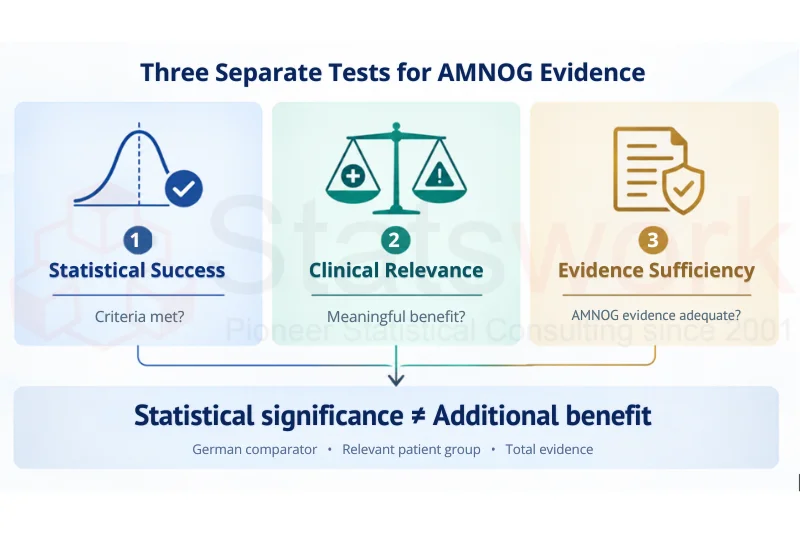
Testing multiple hypotheses without appropriate control can inflate the probability of a false-positive conclusion. Bonferroni adjustment controls family-wise error by dividing the significance level across comparisons. Holm’s procedure also controls family-wise error and is generally less conservative. Hierarchical testing is an option when the sequence is justified and prespecified.
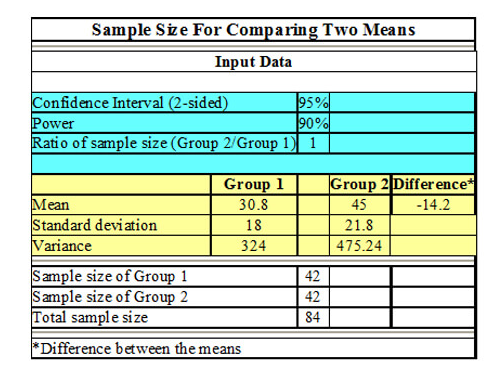
For a time-to-event comparison with a target hazard ratio (HR) of 0.75, two-sided α = 0.05, and 80% power, the Schoenfeld approximation gives approximately 379 required events, assuming proportional hazards and equal allocation between the two groups. [4]
With two comparisons and Bonferroni-adjusted α = 0.025 per comparison, the requirement rises to approximately 460 events per comparison, assuming the same target HR and marginal power.
These figures are approximate and are not additive. In a three-arm trial with equal randomisation and comparable event contributions, 460 events per pairwise comparison correspond to approximately 690 total trial events. Each comparison includes events from two arms, and events in the shared experimental arm contribute to both comparisons. Unequal allocation, different event rates, censoring, and follow-up can change the total requirement.
Finally, 80% power for each comparison does not guarantee an 80% probability that both succeed. If both claims must be demonstrated, assess joint power analytically or through simulation.
Section 4(7) AM-NutzenV permits indirect comparisons in the dossier when direct comparative studies are absent or insufficient to support conclusions about additional benefit. Submission does not guarantee acceptance or establish additional benefit. [5]
Anchored indirect comparisons rely on transitivity: differences between studies must not systematically distort relative treatment effects. Assess populations, effect modifiers, endpoints, follow-up, and study designs. The Bucher method cannot correct important population differences. [6]
Population-adjusted methods such as matching-adjusted indirect comparison (MAIC) and simulated treatment comparison (STC) may help when individual patient data are available for one study and aggregate data for another. In MAIC, a reduced effective sample size indicates limited population overlap and lower precision. Neither method eliminates bias from unmeasured effect modifiers. A changed estimate after adjustment is a sensitivity finding, not proof that population differences caused the original result. [7]
European joint clinical assessment (JCA) can support evidence reuse but does not replace the German AMNOG assessment.
Under §4(2a) AM-NutzenV, when a European dossier has been submitted and the joint clinical assessment has not been discontinued under Article 10(6) of Regulation (EU) 2021/2282, the sponsor must identify, by reference, which evidence from that dossier should form the basis of the German benefit assessment. This requirement does not mean every European assessment automatically triggers the same obligation. [5, 8]
Map the referenced evidence to German patient groups, comparators, endpoints, and analyses. Document missing outcomes or subgroup results and identify additional analyses where necessary. Evidence reuse does not guarantee that the material answers every German comparator-specific question.
How Statswork Can Help
Statswork’s Statistical and Biostatistical Services support comparator-specific estimand development, trial-design evaluation, sample-size and joint-power calculations, multiplicity planning, subgroup analyses, and indirect-comparison diagnostics. These services help sponsors identify evidence gaps before protocol decisions become difficult to change.
Multiple appropriate comparators create distinct evidence questions, not automatic requirements for separate trials. A suitable design links each benefit claim to the relevant comparator, evidence, and statistical analysis. Multiplicity control, adequate event counts, and joint-power assessment help determine whether a trial can support its claims. Indirect comparisons and EU evidence reuse may help, but neither guarantees sufficient evidence for German AMNOG assessment.
WhatsApp us