
What is Facial Recognition and How is it Used in AI?
- Home
- Insights
- Article
- What is Facial Recognition and How is it Used in AI?
Qualitative Research Service
- What is Facial Recognition and How is it Used in AI?
- What is Facial Recognition?
- How Facial Recognition Works in AI
- Applications for Facial Recognition in AI
- Why Facial Recognition Matters in AI
- Role of Data Annotation in Facial Recognition
- Challenges in Facial Recognition AI
- How Data Annotation Services Improve Facial Recognition
- Future of Facial Recognition in AI
- Conclusion
News & Trends
Recommended Reads

Data Collection
As the data collection methods have extreme influence over the validity of the research outcomes, it is considered as the crucial aspect of the studies
- 1. Introduction
- 2. DeepHealth’s Diagnostic Suite™: Revolutionizing Radiology Workflows
- 3. Key Features
- 4. AI Impact on National Screening Programs
- 5. SmartMammo™: Enhancing Breast Cancer Screening
- 6. DeepHealth AI Use Cases Across Specialties
- 7. Strategic Collaborations and Ecosystem Expansion
- 8. Impact and Adoption of DeepHealth’s AI Solutions
- 9. Conclusion: The Future of Radiology with AI
- 10. References
What is Facial Recognition and How is it Used in AI?
Facial recognition utilizes artificial intelligence (AI) as an effective method of identifying or verifying a user’s identity through facial landmarks, including their eyes, nose, mouth, etc. It has moved quickly from being a niche product to being a common form of biometric verification across all types of businesses due to advancements in computer vision, machine-learning techniques, and various deep-learning algorithms [1].
In this pillar guide, we will discuss what facial recognition is, the real-world usage of facial recognition technology, facial recognition technology benefits, challenges that may arise, and how data annotation will assist in the creation of accurate AI systems.
What is Facial Recognition?
Face Recognition is one of the applications of AI that involves analyzing and comparing patterns based on unique facial characteristics of a person. This application makes use of biometrics to map facial features like the distance between the eyes, the nose shape, jawline, etc.
As opposed to the conventional identification systems, face recognition technologies can work in real time, thus having significant potential for automation, surveillance, and personalization [2]
How Facial Recognition Works in AI
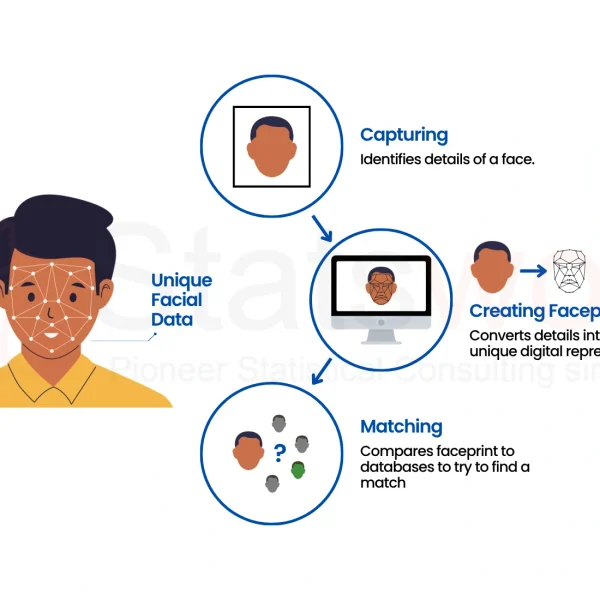
Facial recognition technology requires going through some procedures which include:
1. Face Detection
The procedure requires the detection of a face within the picture or video using computer vision.
2. Feature Extraction
In this procedure, deep learning models such as CNNs are applied to extract important facial features.
3. Face Encoding
Once the features have been extracted, mathematical encoding is done through the generation of faceprint [3].
4. Matching and Recognition
The final step requires matching the generated faceprint with the ones that exist in the database.
All the steps above are powered by AI algorithms and are achieved after being trained with adequate pictures of faces.
Figure 1: How Facial Recognition Works in AI Systems
Applications for Facial Recognition in AI
There are many ways that facial recognition technology can be applied in different spheres due to its efficiency and precision.
1. Surveillance and Security
Facial recognition is used by governments and agencies for securing places from criminals and verifying access control systems.
2. Smartphones
Facial recognition is used by smartphones as an alternative to passwords and PIN codes for unlocking them.
3. Banking and Financial Spheres
Banks apply facial recognition technology during their operations to prevent fraud and verify customer identity [4].
4. Retail Spheres
Companies apply facial recognition technology to track customers’ activities and provide them with personal assistance.
5. Healthcare
Facial recognition technology helps hospitals identify patients, keep their information and even determine their emotions.
6. Social Media
Social media apply facial recognition technology to provide personalized advertising and tagging.
Why Facial Recognition Matters in AI
The use of facial recognition technology is changing how businesses and systems engage with users. The significance of technology is in:
- Increased levels of security with biometric identification
- Quicker identification processes without user interaction
- Better customer experience through personalization
- Automation of identity identification processes [5]
As more systems are being driven by AI technology, facial recognition remains an important development.
Role of Data Annotation in Facial Recognition
Data annotation is essential for facial recognition technology.
Training algorithms need significant amounts of data that are annotated accurately.
The most common types of data annotation include:
- Image annotation – annotating facial images
- Facial landmark annotation – marking specific landmarks such as eyes, nose, and mouth
- Bounding box annotation – highlighting face areas
- Semantic segmentation – categorizing pixels on an image
Poor quality annotation can lead to inaccuracies and biases in facial recognition models [3].
Challenges in Facial Recognition AI
Facial recognition has some difficulties despite its many strengths:
Privacy and ethical issues
- AI bias arising from bad datasets
- Problems with accuracy when conditions are low-light or crowded
- Regulation and compliance problems
These difficulties can be overcome by using proper datasets, ethical AI practices, and proper annotation processes.
How Data Annotation Services Improve Facial Recognition
Professional data annotation services provide:
- Quality labeled data sets to train AI algorithms
- Increased accuracy and efficiency of models
- Decreased bias by ensuring diversified labeling of data
- Scalability for massive AI initiatives
Through professional data annotation services, organizations can construct better facial recognition systems [4].
Future of Facial Recognition in AI
The future of facial recognition technology is linked to developments in artificial intelligence and machine learning. Future trends include:
- Real-time facial recognition for smart cities
- Integrating with Internet of Things (IoT) and edge computing
- Development of privacy-preserving AI algorithms
- Facial emotion and behavioral recognition
With further developments in AI, facial recognition technology is set to become increasingly precise, secure, and popular [5].
Conclusion
Facial recognition is a revolutionary AI application that is changing industries with automation, security, and personalization. But its effectiveness relies largely on the data fed into AI models.
Statswork specializes in data annotation that powers facial recognition algorithms.
Reference
- Khan, Z. A., & Rizvi, A. (2021). AI based facial recognition technology and criminal justice: issues and challenges. Turkish Journal of Computer and Mathematics Education, 12(14), 3384-3392. https://www.proquest.com/open
- Gupta, S., Modgil, S., Lee, C. K., & Sivarajah, U. (2023). The future is yesterday: Use of AI-driven facial recognition to enhance value in the travel and tourism industry. Information Systems Frontiers, 25(3), 1179-1195. https://link.springer.com/article
- Arwert, I., Mehlan, A., Rook, J. G., & Wenning, J. (2024). Facial Recognition in the Public Space: Challenges and Perspectives. Code and Conscience: Exploring Technology, Human Rights, and Ethics in Multidisciplinary AI Education, 1-16. https://link.springer.com/chapter
- Sunar, S., Tripathi, S. K., Tiwari, U., & Srivastava, H. (2021, September). A comparative study on face recognition AI robot. In Proceedings of Second Doctoral Symposium on Computational Intelligence: DoSCI 2021(pp. 211-221). Singapore: Springer Singapore. https://link.springer.com/chapter
- El Fadel, N. (2025). Facial recognition algorithms: A systematic literature review. Journal of Imaging, 11(2), 58. https://www.mdpi.com/2313-433X/11/2/58