
How to Turn Raw Audio into Research Insights | Statswork

How to Turn Raw Audio into Research-Ready Insights Using Transcription and Open-Ended Coding

How to Turn Raw Audio into Research-Ready Insights Using Transcription and Open-Ended Coding

May 2025 | Source: News-Medical

Introduction

In qualitative research, raw audio can be a trove of information, depicting stories, emotional response and in-depth beliefs. However, unless the raw audio data is transcribed and open coding subsequently performed on it, the data is effectively hidden and in a unstructured state. Transcription and open coding are the missing piece of the puzzle that enables researchers to process voice recordings into knowledge that can be applied to their research. Transforming speech data from interviews, focus groups, or open-ended survey responses into structured, analysable data is a vital step to induction research.
In this guide, we will outline the process from raw-data ingestion to final analysis and discuss how modern tools and expert-processes can help you maximize the outcomes of qualitative research.
1. Understanding the Importance of Transcription and Coding

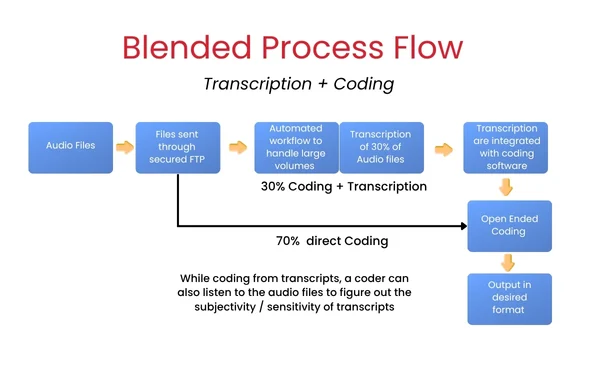
Transcription is the process of turning audio or video recordings into written text. Open-ended coding refers to the process of organizing qualitative text into themes, patterns, and concepts that express an inherent message. Together, these methods can:
  • Ensure respondent voices are retained, with context
  • Provide detailed analysis on emotions, themes
  • Assist in decision-making in various areas like healthcare, education, UX/CX, and market research
Without these steps in the process, qualitative research runs the risk of being anecdotal, subjective, or not actionable.[1]

2. Step-by-Step Process to Turn Audio into Insights

Step-by-Step Process to Turn Audio into Insights

Step 1: Audio Ingestion & Formatting

The very first thing you should do to load it up is to collect audio files from all your interviews, discussions or focus groups. You can take all of it as .mp3 or .wav files, or even as transcripts as PDFs. As you collect audio files make sure everything is comprehensible audio, complete sentences, timestamped in some sort of order, and otherwise grouped with sorted metadata (speaker ID, session 1/2 number, …etc)

Step 2: Goal Alignment

Define your goal of the research:
  • Are you investigating customer sentiment?
  • Investigating themes that emerged?
  • Preparing data for compliance reporting?
You are identifying your goals, which will guide the amount of transcription detail that’s required or the detail of coding’s you’ll use.[2]

Step 3: Transcription (AI-Assisted + Human Reviewed)

Check out some tools like Otter.ai, Trint, or Descript for AI-powered transcriptions. But always follow up with a human review to right any misinterpretations and to understand domain-specific jargon, accents, and emotion indicators. Types of transcription:
  • Verbatim: a complete transcript capturing all word-stumbles and all fillers (e.g. “uh”, “you know”)
  • Clean Read: no fillers, and any grammar errors corrected for easy analysis.
  • Timestamped: this method is great for aligning
  • Paper: A hard copy of a transcript.

Step 4: Structuring Metadata

Organize project transcripts with speaker labels, session identifiers, and time stamps will assist with traceability and allow for more efficient thematic mapping when analysis occurs.

3. Applying Open-Ended Coding

When the transcription has been completed, it is time to conduct open-ended coding. Manual Thematic Coding Researchers will, at this point, read a transcript line-by-line in order to code. A ‘code’ is a short label used for an idea or sentiment. Example of codes include “customer frustration”, “easy to use”, and “trust in brand”. Types of Coding Techniques
  • Open Coding: Initial classification of all ideas
  • Axial Coding: Linking codes together and classifying them into categories
  • Selective Coding: Finding a core theme or narrative
Automated Tools That Assist Tools such as NVivo, MAXQDA, Atlas.ti, and Dedoose function to assist and allow for manual and assisted coding. They allow for the recording of code frequencies, word clouds, co-occurrence mappings, and can also export reviewed material to allow the use of graphing tools such as Tableau or SPSS.[3]

4. Ensuring Accuracy and Compliance

When conducting transcription and coding with good quality, you’ll need the following:
  • Human-in-the-loop validation! AI tools allow for speed, while humans offer context and accuracy.[6]
  • Domain’s knowledge! A coder must know the specific language of the industry if a coder is coding healthcare, they must know the difference between, “adult” and “paediatric,” or, “rural” and, “urban.”[5]
  • Regulatory compliance! The transcripts need to meet the regulatory requirements of the IRB, HIIPA or GDPR depending on the level of sensitivity of the regulated industry.

5. Delivering Research-Ready Outputs

Some common final deliverables include:
  • Clean, time-stamped transcripts
  • Codebooks (with definitions and examples if desired)
  • Thematic summary and sentiment analysis
  • Excel or CSV files for importing into NVivo, SPSS, or visual dashboards
The structured format allows stakeholders to easily extract insight, compare responses, or generate reports quickly.[4]

Conclusion

There is no reason to be daunted when it comes to converting voice to useful research insights. By taking a structured approach that incorporates transcription accuracy, purposeful coding, and relevant tools researchers are able to derive rich, qualitative insights from voice data. At Statswork, we take the best of AI efficiencies combined with the human touch to ensure the qualitative data collected is accurate, compliant, and ready for analysis, regardless of project complexity.

Whether you are conducting research as an academic, in healthcare, or as a product strategist, following the workflow of transcription and coding the data in the right way can uncover the true value in each conversation.

References

  1. Eftekhari H. (2024). Transcribing in the digital age: qualitative research practice utilizing intelligent speech recognition technology. European journal of cardiovascular nursing23(5), 553–560. https://pmc.ncbi.nlm.nih.gov/articles/PMC11334016/
  2. Skukauskaite, A. (2012, January). Transparency in transcribing: Making visible theoretical bases impacting knowledge construction from open-ended interview records https://www.qualitative-research.net/index.php/fqs/article/view/1532
  3. Cope, M. (2010). 27 Coding Transcripts and Diaries. Key methods in geography, 440.https://books.google.co.in/books?hl=en&lr=&id=_wk4kVABqE4C&oi=fnd&pg=PA440&dq=Transcription+and+open-ended+coding+&ots=Q5f22vKl4o&sig=Lkzy3wrPCq4_F37ZIh3kaQ4RoF8&redir_esc=y#v=onepage&q=Transcription%20and%20open-ended%20coding&f=false
  4. Covell, C. L., Sidani, S., & Ritchie, J. A. (2012). Does the sequence of data collection influence participants’ responses to closed and open-ended questions? A methodological study. International journal of nursing studies49(6), 664-671. https://www.sciencedirect.com/science/article/abs/pii/S0020748911004652
  5. Stuckey, H. L. (2015). The second step in data analysis: Coding qualitative research data. Journal of social health and diabetes3(01), 007-010.https://www.thieme-connect.com/products/ejournals/abstract/10.4103/2321-0656.140875
  6. Cascio, M. A., Lee, E., Vaudrin, N., & Freedman, D. A. (2019). A team-based approach to open coding: Considerations for creating intercoder consensus. Field methods31(2), 116-130.https://www.ssoar.info/ssoar/handle/document/57717