
The Importance of Editorial Design in B2B

The Importance of Editorial Design in B2B

May 2025 | Source: News-Medical

How to Ensure Annotation Quality in Your AI Training Data

Good design is not just decorative, it elevates your messaging. In B2B industries like finance, SaaS, healthcare, and Consulting, the most successful layouts help decision-makers to process, interpret insights, build trust, and act rapidly and simply. Editorial design plays an important role in helping take complex content, and engage with the reader by: • Reinforcing credibility by way of professionalism [2] • Emphasizing key data and significant points • Directing the reader’s attention to what matters most • Maintaining brand consistency across all channels. [2]

Who is Impacted by Impact Analytics

Impact Analytics affects all business functions typically related to a B2B company:

Role/TeamWhy It Matters
ExecutivesNeed clarity into ROI before making large investments
Marketing TeamsNeed to prove the impact of the campaign to pipeline or sales
Product ManagersWant to identify which features drive retention
HR / OperationsNeed to measure outcomes of any policy or technology change
ConsultantsMust link their service to measurable client value

Editorial Design Challenges for B2B Companies

Disorganized Content  Excessive text with no hierarchy can overwhelm readers.[1] Inconsistent Style A mix of typography, color palette, or layouts weaken your brand message.
Design Gaps between Formats What looks good on print may not on the web, or on mobile. [3] Pitfalls of DIY Design  The untrained feel and look of amateur layouts affect your credibility and distract from your value.

How Statswork Can Tackle These Problems

Solution What It Does
Structured Layouts Grid-based templates with visible hierarchy improves clarity and focus.
Managing Style Guides We enforce consistent fonts, colors and brand elements across documents [1].
Infographics & Visually Simple Complicated data is turned into simple charts and diagrams.
Cross-Platform All designs are responsive; on paper, on web, and on mobile.
Templates & Checklists We create reusable templates and have systems for teams to use to maintain consistency. [3]

What Makes Our Approach Work

  • Business-first design–what is most important to your core message and goals
  • Non-technical friendly–materials anyone on your team can update
  • Action-oriented layouts–easy to follow calls-to-action and logical flow
  • Repeatable systems–a way for to assure a high-quality output as you scale your plan

Editorial Design: A Practical Guide

This guide is intended for marketing managers, internal comms leads and corporate strategists tasked with creating or approving content; it defines frameworks, best practices and tools to help with publishing across functions.

What is Editorial Design

Editorial design is the art of coordinating text, images and brand elements into cohesive layouts that encourage understanding, engagement, and action. It synthesizes typography, layout, color, and imagery as a tool to enable strategic objectives [1].

Basic Principles for Editorial Design


Hierarchy & Readability  Establish a clear hierarchy using headings, subheading and callouts that help guide the reader. [1]

Brand Consistency 

Use the same fonts, colors, and styles for a consistent look.

Modular Design

Create templates that are flexible for many representations such as print, PDF, or electronically.

Mobile & Digital First

Check that text and images can adjust to fit every size and shape of device.

Types of Editorial Design

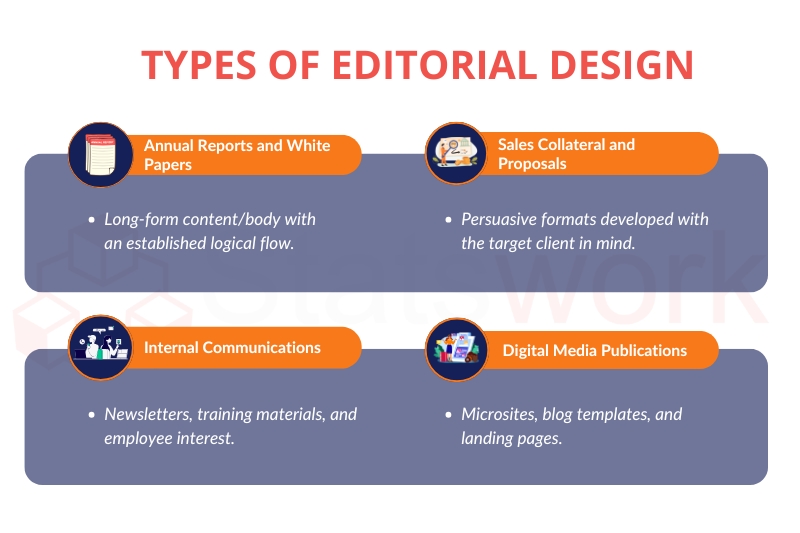
Annual Reports and White Papers Long-form content/body with an established logical flow. Sales Collateral and Proposals Persuasive formats developed with the target client in mind. Internal Communications Newsletters, training materials, and employee interest. Digital Media Publications Microsites, blog templates, and landing pages.

Major Methods and Models

Method Purpose
Grid Layouts Encourage consistency and visual balance.
Style Guides Establish guidelines for colour, imagery and typography.
Data Visualization Approaches Select chart type to enhance data clarity.
Modular Design Divide content into blocks that can be reused for efficiency.

Software and Tools

Tool

Use Case

Adobe InDesign

Professional layouts for print and e-books

Figma / Sketch

Collaborative digital design experiences

Canva / Lucidpress

Quick, easy templates to assist a marketing team

PowerPoint / Word

user-friendly formats for internal templating

Editorial Design Examples

Annual Report for SaaS Company

With data callouts and branded styles → 25% increase stakeholder engagement. [2]

Consulting Proposal Template

Because of the new modular template, there is a faster turnaround in completing proposals and a 15% increase in acceptance.

Corporate Newsletter

When mobile optimized, it resulted in 40% more opens and read.

Frequently Asked Questions (FAQs)

    1. Is editorial design just about looks?

    No. It is a strategic tool that highlights essential messages and increases comprehension.

    1. Can we do this internally? [3]

    Yes, you may be able to produce better content with templates, training, and support—but consistent quality can be very difficult to maintain without expert assistance.

    1. How long does an editorial project take?

    Templates and style guides: approximately 2–4 weeks; Full reports or publications: could take between 4–8 weeks depending on complexity. 

    1. Do we need high-end layouts or design software?

    Not all the time. Many B2B teams produce solid outputs using Word, PowerPoint, or Canva. 

    1. How do we ensure consistency with the brand?

    Customizable style guides and editable templates help to produce content that is consistent with your brand.

Conclusion

Conclusion

Strategic editorial design converts base materials into meaningful and reliable communication. It is a strategic communication mechanism for B2B organizations, as it provides clarity, engagement with the audience, and brand credibility.

Are you ready to add clarity and meaning to all your content? Let’s design for impact.

References

References

  1. “Readability: The Optimal Line Length” – Baymard Institute
    Research shows that appropriate line length dramatically improves readability and comprehension—critical for B2B audiences processing dense content.
    https://baymard.com/blog/line-length-readability

  2. “Visuality in Corporate Communication” by Özen Okat & Bahadır B. Solak – ResearchGate
    Explores how visual design strengthens brand identity and aids comprehension in corporate communications.
    https://www.researchgate.net/publication/338187901_Visuality_in_Corporate_Communication

  3. “Assessing readability and discussing relevance to practitioners” – Nottingham Repository
    A study on the importance of readability in B2B marketing research, reinforcing why structured, clear design is essential.
    https://nottingham-repository.worktribe.com/OutputFile/3853211

  4.