
As the data collection methods have extreme influence over the validity of the research outcomes, it is considered as the crucial aspect of the studies
May 2025 | Source: News-Medical

As artificial intelligence (AI) continues to power smarter applications across all industries, the need for high-quality training data is greater than ever. Whether you are training your model for natural language processing, computer vision, or voice recognition, your AI performance relies heavily on how well your data is annotated.
Because without high-quality annotations, poorly annotated training data can lead to biased models, misclassifications, and in the worst-case scenario, complete AI failure in the real-world. But how can you be sure that you are meeting the level of annotation quality requirements for your AI solution?
In this article, we will discuss the value of annotation quality, what factors influence it, and we will share tips for how identify and achieve high-quality annotations for your training data.

The process of data annotation is the process of labelling data—whether it be text, images, video, or audio—so that machines can understand it. Data annotation is fundamental to supervised machine learning, in which models learn patterns from labelled examples.
If the data annotations are inconsistent, incomplete or incorrect, the model will learn incorrect relationships—resulting in:
High-quality annotation helps assure your model understands the world in the same manner as humans—obviously, accurately, and with the least amount of error.

Before we get into best practices, it’s helpful to clearly define quality in the context of data annotation. Quality data can be defined by the following conditions:
Any area of poor quality will negatively impact your AI accuracy for the future [2].
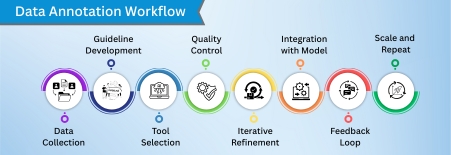

Prior to putting down the first label, you should have prepared and finished a set of clear and elaborate annotation guidelines. Guidelines should state:
Your annotators—regardless of if executed in-house, or third party—should be on the same page on what is expected, you can always modify and update the guidelines as your project changes.
Certain domains require subject matter expertise, for example, healthcare, legal, or finance. Hiring general annotators for more complex tasks such as labelling X-rays, medical files or legal documents can create errors due to misunderstanding.
Solution: Hire or consult subject matter experts to directly annotate or to oversee an annotation team to ensure quality and compliance (e.g. HIPAA, GDPR) [3].
Quality assurance should never be an afterthought. Incorporate any of these techniques into your pipeline:
Adopting any regular QC practice will yield praise since errors will be prevented early on before they compound.
Never presume that every annotator knows exactly what to do the day they start. Even annotators with a lot of experience are always learning. This is especially true when: These points highlight new labels or features, changes to annotation rules, or changes in the use case or data type.
Regularly implement things like tests, quizzes, and feedback sessions to provide consistent reinforcement.
Today’s annotation platforms have many features such as anomaly detection, reviewer workflows, and real-time reporting. Select a platform with features that allow you to:
These tools help increase efficiency while also concentrating on the quality [4].
A HITL strategy means the humans are connected to the model during its training and validation phases. It can:
This hybrid strategy improves both the quality of annotated data and model performance cumulatively.
In their eagerness to train models quickly, some teams only care about how much data they have. A mistake. Even if they have a lot of data, if it is badly labelled, the models they produce will be less reliable. Start small, perfect your annotation, then scale up. It is true what they say, “Garbage in, garbage out.” [5]
Data annotation is not simply “set and forget.” You should periodically review:
Look for trends, retrain the underperforming annotators, and adjust the processes.
A typical communication gap in AI Teams is between the engineers developing the models and the people preparing the data through annotation.
Promote regular check-ins to:
When annotation teams understand the relevance of their work for model accuracy, it improves motivation and ultimately, quality [4].
As your model becomes less biased or better, you can begin to use the outputs from your model to help guide the annotation activities. For example, you can utilize the outputs of your model in two modes:
Overall, these approaches will allow you to make the annotation process even more meaningful and efficient–and you can use model outputs to focus on the areas in the annotation process that require the most additional effort, work, and targeted feedback.

Data annotation is often the unseen structure behind many of the A.I. systems today, and quality is what ties it together. When you have unreliable, inaccurate annotations, even the most advanced machine learning models are likely to fall short.
You can make sure that your training data enhances—rather than disrupts—any A.I. intentions you have, by designing a solid process, utilizing quality tools, engaging subject matter experts, and keeping a close eye on your data pipeline.
In the quest to develop more intelligent machines, the goal isn’t just to label faster, it’s to label better.



WhatsApp us