

What are the different techniques in data-driven marketing?
June 2, 2021
How machine learning analytics and metrics could be effectively used in retailing research
June 4, 2021How to Identify Your Client Needs Through Your Organizational ERP Software Solutions
Introduction to ERP and Client Requirement Analysis
In this decade, most complex tasks are concise using automation technology for rapid accessibility and reliability. Client need examination combines both qualitative and quantitative research methods with the goal of better understanding of client base. Knowing what makes your customers tick means you’ll be able to cater to their specific needs. Likewise, many organisations were struggling once to manipulate and handle their organizational requirements like Accounting, Project management, Risk Management, Procurement, Supply chain operations, and People analytics management through business process automation. The origin of ERP (Enterprise Resource Planning) and modern ERP software solutions put an end to the complex scenarios in the above management areas.
The need for ERP implementation services is to mark the Client requirements based on the ERP protocols and guidelines. Many software and tools support organisations to plan the budget, predict and forecast reports for the project data using enterprise data management systems. As per the proposed work, ERP plays a vital role in this decade in both public and private sectors in financial services, professional and procedural activities, business and administrative operations. Predictive analytics identifies hidden connections between key factors contributing to employee turnover and overall organizational performance management.
Enterprise Resource Planning and Business Process Automation
ERP plays a crucial role in integrating the organization’s business strategies based on delegated protocols to attain the target. The key responsibility designed for ERP systems is to track and monitor the organization’s routine objectives and maintain them in a stable platform to induce productivity through centralized enterprise resource planning software.
In recent days, many ERP software solutions are designed for organisations according to their requirements and commitments. Based on the roles and responsibilities of the organisation, ERP software can be determined and customized through ERP implementation services. The proposed work illustrated the expansion of ERP in Russia from the last decade to induce productivity.
ERP in Client Requirements and Business Intelligence Solutions
the requirements of the Client through structured client requirement analysis. To attain stability, the organisation must understand the Client’s basic requirements to deliver the exact product or service. Certain functional modules of ERP systems play a crucial role in marketing automation, accounting, Business Intelligence solutions, Human Resources, production, and services.
There is a checklist based on the ERP modules followed by every organisation regarding the various norms and protocols according to the organizational culture to satisfy the clients using integrated enterprise software solutions.
Implementing ERP in Client Requirements Using ERP Implementation Services
It is always necessary to understand and identify the client requirements and produce the exact outcome as per the Client’s request; Organization Qualitative Data Analysis Services is the process of appraising the growth, personnel, operations, and the changes they experience, so that they can reach their desired level of customer satisfaction through structured ERP implementation strategies. Certain phases are there to achieve client satisfaction.
Step 1: Requirement Analysis in ERP Systems
Gathering the inputs from the clients for the product or service as per the user perception and from the business perception through systematic client requirement analysis.
Step 2: Comparison and Sourcing through Enterprise Protocols
Comparing the requirements to whether those requirements can be satisfied by the team and analysing clients’ requirements based on the enterprise norms and protocols within ERP software solutions.
Step 3: Financial Diligence and Budget Planning
Based on the requirement analysis, the financial team has to verify and evaluate that the production cost and the Client’s budget are the same or not using ERP financial management modules.
Step 4: Production or Designing Phase in ERP Workflow
Initiating the production of a product or service as per the requirements using ERP-based workflow automation. Once the production is done, the testing team will take care of the next phase to satisfy the users, test the product internally from the user perspective.
Step 5: Testing or Rebuilding in ERP Quality Management
If there is any issue found in the testing issue, the issue can be rectified by rebuilding the product or service with the coordination of the developing or production team. After the process, the product or service will be deployed to the Client with a discussion regarding the process in the production or development phase, testing, and maintenance phase under ERP quality control systems.
Step 6: Deployment and Maintenance through ERP Support Systems
After completing the product or service, the handover of the product or service to the Client with proper rights and ownership will be done. The maintenance of the product or service may be followed and handled by the developed or produced organisation, or it may depend upon the product or service under ERP maintenance management modules.
Step 7: Documentation and Report Generation Using ERP Analytics
In this phase, all product or service development processes will be tracked and monitored for future purposes using ERP analytics tools. The data and information occurred in every phase submitted as a report. Those report generation processes will be helpful for both the Client and also for the organisation to maintain the product or service efficiently through enterprise reporting systems.
These are the major phases in ERP for clients. In every phase of the ERP, the Client’s intervention is highly recommended to produce the highest expected outcome using structured ERP software solutions.
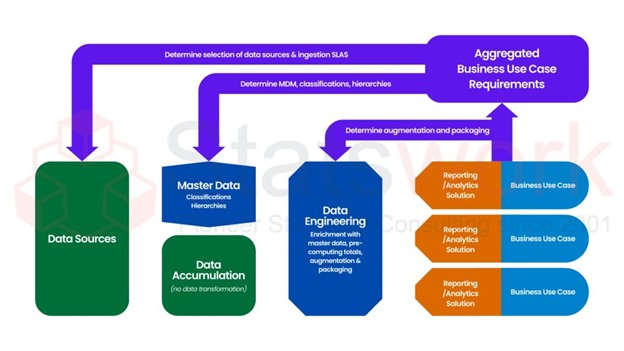
FIGURE: ERP system concepts

Conclusion and Future Scope of ERP Software Solutions
The client requirements can be effectively identified using Enterprise Resource Planning systems. It is reliable and accountable for ERP software solutions and tools to process the requirements from the client perspective and convert the product into user-friendly through advanced business process automation.
Companies want to take advantage of ERP’s benefits but don’t want to spend a lot of money or time putting it in place through ERP implementation services. They also want to see their ERP framework integrated with their current subsystems as soon as possible and with a high level of customization.
Companies are more likely to use mobile apps integrated with ERP systems to have continuous access to information and use this ability to extend their scope for consumers as more people use mobile devices to communicate with others, do business, and access information.
Reference:
- Mahar, Farhan, et al. “ERP system implementation: planning, management, and administrative issues.” Indian J. Sci. Technol 13.01 (2020): 1-22.
- Mathar, Divya, and Mithun Gaur. “Change Management: Identifying Change Agents Using Social Network Analysis in an ERP Implementation.” International Journal of Computer Engineering & Technology (IJCET) (2020
- Gill, Atif Ali, Shaheera Amin, and AmmaraSaleem. “Investigation of Critical Factors for Successful ERP Implementation: An Exploratory Study.” Journal of Business and Social Review in Emerging Economies 6.2 (2020): 565-575.