
What is Machine Learning
- Home
- Insights
- Article
- What is Machine Learning
Qualitative Research Service
News & Trends
Recommended Reads

Data Collection
As the data collection methods have extreme influence over the validity of the research outcomes, it is considered as the crucial aspect of the studies
- 1. Introduction
- 2. DeepHealth’s Diagnostic Suite™: Revolutionizing Radiology Workflows
- 3. Key Features
- 4. AI Impact on National Screening Programs
- 5. SmartMammo™: Enhancing Breast Cancer Screening
- 6. DeepHealth AI Use Cases Across Specialties
- 7. Strategic Collaborations and Ecosystem Expansion
- 8. Impact and Adoption of DeepHealth’s AI Solutions
- 9. Conclusion: The Future of Radiology with AI
- 10. References
Introduction
Machine Learning is a subset of AI and is centered around making it possible for computers and systems to ‘learn’ from data, establish patterns and ultimately, increase their performance based on their own experience. Machine Learning is used to develop predictive models based on historical and real-time data.[1]
Core components of Machine Learning consist of:
Data-Driven Learning
- Data, both structured and unstructured, serves as the primary input to machine learning (ML) systems.
- Machine Learning algorithms use historical and current data to identify relationships, trends, and other unknowns in data that may not have been revealed by traditional statistical methods.
Model Training and Improvement
- ML systems are created from representative datasets that represent the characteristics of the target population, and the models are built using extensive iterative learning processes.
- So that the ML systems are continually improved as new data becomes available, the systems need to be retrained/updated with new data to continue to provide increased accuracy, reliability, and generalization to different environments.
Types of Machine Learning
- Supervised Learning: Labeled data is used to train models to infer or predict the outcome of a known event or outcome.
- Unsupervised Learning: Hidden patterns or groupings in unlabeled datasets are found and learned by algorithms.
- Semi-supervised Learning: A confluence of both labeled and unlabeled data is necessary for algorithm improvement.
- Reinforcement Learning: Optimal actions are learned through experimentation, receiving feedback, and providing rewards.[3]
Algorithmic Techniques
- Machine Learning systems employ a broad variety of techniques ranging from regression to classification, clustering, and decision trees, and a variety of ensemble methods and support vector machines.
- As well as several other techniques that are determined depending on the characteristics of the data and the level of complexity of the problem.[3]
Automation of Decision Processes
Machine Learning systems create the ability to automate both the process for analytics, as well as for decision-making, through consistent, repeatable, and data-based outputs providing the benefit of eliminating human intervention and potential bias.
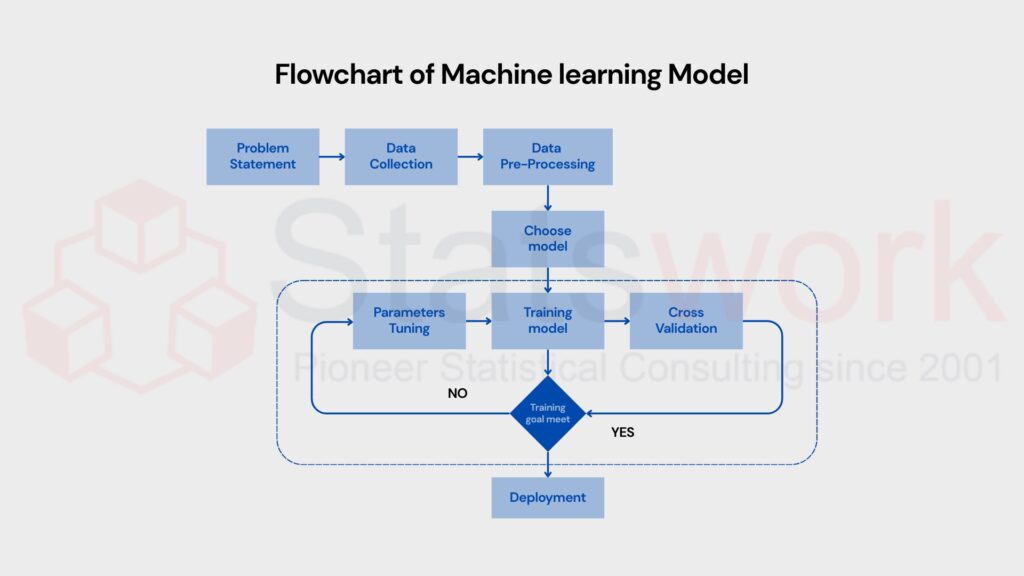
Fig 1 Shows the end-to-end process of building, training, validating, and deploying a machine learning model.
Scalability and Adaptability
Machine Learning systems are built with the ability to be able to scale with large quantities of data and adapt with a changing data pattern, allowing them to continue to perform as both the amount and complexity of the data increase.
Integration with Advanced Technologies
With the help of Machine Learning, there are multiple advanced capabilities of Artificial Intelligence, like Deep Learning, Computer Vision and Natural Language Processing that allow Analysts to create more advanced analytical applications.
Real-World Applications
Machine Learning is very popular in many different types of domains, including Healthcare Analytics, Financial Modelling, Risk Assessment, Recommendation Systems, Cybersecurity, Scientific Research, etc., which enables Intelligent/Efficient Solutions.
Unlock the power of data with StatsWork’s expert AI & ML solutions today!
References
- El Naqa, I., & Murphy, M. J. (2015). What is machine learning?. In Machine learning in radiation oncology: theory and applications(pp. 3-11). Cham: Springer International Publishing. https://link.springer.com/chapter/10.1007/978-3-319-18305-3_1
- Ayodele, T. O. (2010). Types of machine learning algorithms. New advances in machine learning, 3(19-48), 5-1. https://books.google.co.in/books?hl=en&lr=&id=XAqhDwAAQBAJ&oi=fnd&pg=PA19&dq=Types+of+Machine+Learning