

Why framing research question and storyboard development is important before analyses?
February 18, 2021
What are different phases of clinical trials and how to design and analyze?
February 23, 2021How to Create a Codebook for Survey Research?
Meta Analysis Service
Recommended Reads
Contact us
Summary:
A codebook is an integral part of surveys and is used to relate variables to value labels and missing data codes in order to have standardized survey data analysis. A codebook works as a qualitative coder and as a way of documenting the data file, which is important in qualitative research design. Creating an organized codebook will help improve intercoder reliability and data validation rules.
Whether you are working on a large-scale quantitative study or an in-depth qualitative research design project, a well-structured codebook is your most reliable compass. It anchors your survey data analysis, ensures consistency in qualitative coding, and prevents costly errors down the line. In fact, understanding how to create a codebook is one of the first practical skills every researcher should master [1].
What Is a Codebook in Research?
Codebook is an organized guide which helps in explaining what the dataset contains and how the data can be coded. Codebook is basically the connection between your initial survey answers and analysis. To put it more simply, codebook is a data dictionary; however, it is not just any data dictionary codebook vs codebook discussion, but the one pertaining to a certain survey form and its rules of coding.
Typically, a codebook in qualitative research and in quantitative research includes:
- Variable names, variable labels and placement of the variable in the data file
- Value labels – text label for the numeric code
- Missing values and how to treat skips in the survey
- Coding scheme or code frame for open ended questions
- Data verification rules in order to assure data quality in the survey data clean up process
- Codebook metadata such as data set name, version and latest revision date [2]
Why Is a Codebook Essential for Survey Research?
Even the best-collected data from a survey becomes meaningless without a codebook – even more so if different researchers analyze that data set. The reason intercoder reliability (a degree of concordance among the researchers who code a data set) strongly relies on the existence of a common reference document. No matter whether your methodology involves a grounded theory approach, thematic analysis, or a well-planned SPSS codebook process, the creation of a codebook brings about a common language you need.
Reasons to develop a codebook at the very beginning of your research project:
- Maintains coding of categorical variables consistently across your whole research team
- Eases the creation of SPSS codebook and import of data into any statistical software
- Avoids mistakes in survey data cleaning and validation
- Helps in documenting your survey instruments permanently
- Contributes to the secondary analysis of that data set later [3]
Step-by-Step: How to Create a Codebook
Creating a codebook does not need to be overwhelming. Follow these structured steps to build a reliable qualitative codebook or quantitative codebook for your survey project.
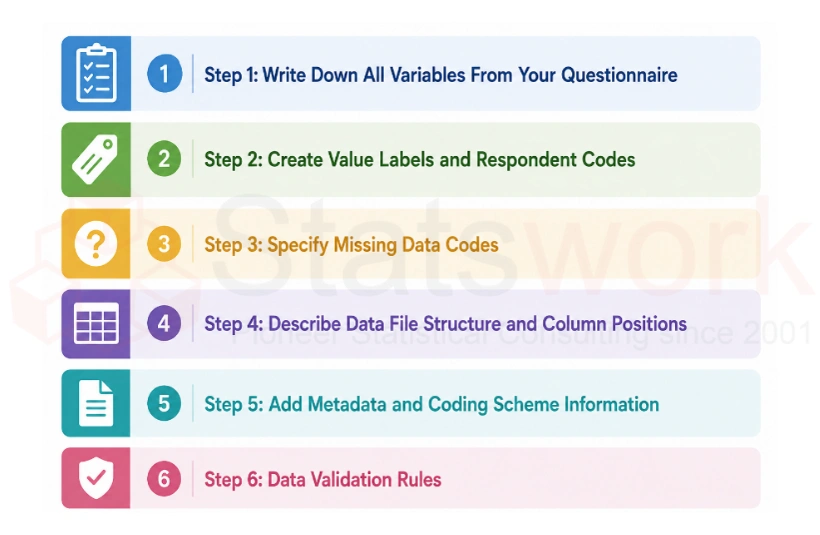
Step 1: Write Down All Variables From Your Questionnaire
Write down all questions from your survey as variables. Give each of these variables a short descriptive name. Don’t use spaces in the names to make it easier to write SPSS codebook. Also give a descriptive variable label up to 40 characters.
Step 2: Create Value Labels and Respondent Codes
To all closed ended responses, assign numeric code and describe the value labels – the meaning of each of those codes. For instance, if you are using Likert scale then “1 = Strongly Disagree” to “5 = Strongly Agree.” That is how you respond coding procedure should be conducted.
Step 3: Specify Missing Data Codes
Create universal missing data codes which would stand for “Refused,” “Don’t Know” or “Not Applicable”. Values like 9 or 99 are normally used as missing values of numeric fields.
Step 4: Describe Data File Structure and Column Positions
Describe the column position and width of each variable in your data set. That is especially important if you are dealing with fixed-width data files. If one of the variables occupies more than one column then you need to describe each column.
Step 5: Add Metadata and Coding Scheme Information
Metadata about the codebook to include are the name of the dataset, version number, date created, and the name of the coder. In case you are doing qualitative coding in grounded theory, it would be important to document the coding scheme, i.e., how categories and themes were developed [4].
Step 6: Data Validation Rules
Data validation rules must be set up for each variable, e.g., for age, you may allow values from 18 to 99 years old.
Qualitative Codebook Example: What to Include
The use of codebooks in qualitative research enables standardization of theme and category application in textual data. An example of a qualitative codebook in an interview-based study exploring healthcare experiences may comprise:
Code Name: Patient-Provider Trust
- Definition: Any quote where the participant talks about the degree of his/her confidence in the medical advice provided
- Criteria for inclusion: Quotes containing words such as trust, belief, doubt, reliance on providers
- Criteria for exclusion: Quotes containing words such as costs, logistics, access issues
- Sample quote: “I always heed what my doctor says because he listens to me.”
- Related codes: Quality of Communication, Provider Empathy [4]
Conclusion
An efficient codebook is not merely an organizational procedure; rather, it is a scientific process that ensures that your research survey data is protected and secured from the beginning to the end. No matter whether you are dealing with categorical variable coding in quantitative surveys or grounded theory in qualitative coding, your codebook becomes the most critical document for you and your team.
At Statswork, our team of professionals provides you with comprehensive Survey Data Analysis Services, which include qualitative data analysis, codebook development services, SPSS codebook preparation services, and survey instrument documentation services.
Frequently asked question:
A codebook in survey research is a document that defines all survey variables, response categories, coding schemes, and data labels to ensure accurate data analysis and interpretation.
A codebook can be created in Excel by organizing variable names, descriptions, response options, coding values, and measurement scales into a structured spreadsheet.
A codebook should include variable names, variable descriptions, coding values, response categories, data types, measurement scales, and any instructions required for data interpretation.
ChatGPT can assist with qualitative coding by identifying themes, categorizing responses, and suggesting codes based on textual data provided by researchers.
The four main types of data in statistics are nominal, ordinal, interval, and ratio data, each differing in how values are categorized and measured.
References
- Oliveira, G. (2023). Developing a codebook for qualitative data analysis: Insights from a study on learning transfer between university and the workplace. International Journal of Research & Method in Education, 46(3), 300-312.https://www.tandfonline.com/doi/abs/10.1080/1743727X.2022.2128745
- Turner-Essel, L., & Ryan, K. (2023). Qualitative phase: Codebook development. In Ethics and clinical neuroinnovation: Fundamentals, stakeholders, case studies, and emerging issues(pp. 229-250). Cham: Springer International Publishing.https://link.springer.com/chapter/10.1007/978-3-031-14339-7_13
- Ritchie, M. J., Drummond, K. L., Smith, B. N., Sullivan, J. L., & Landes, S. J. (2022). Development of a qualitative data analysis codebook informed by the i-PARIHS framework. Implementation science communications, 3(1), 98.https://link.springer.com/article/10.1186/s43058-022-00344-9
- Barany, A., Nasiar, N., Porter, C., Zambrano, A. F., Andres, A. L., Bright, D., … & Baker, R. S. (2024, July). ChatGPT for education research: Exploring the potential of large language models for qualitative codebook development. In International conference on artificial intelligence in education(pp. 134-149). Cham: Springer Nature Switzerland.https://link.springer.com/chapter/10.1007/978-3-031-64299-9_10
Contact us

Related posts